

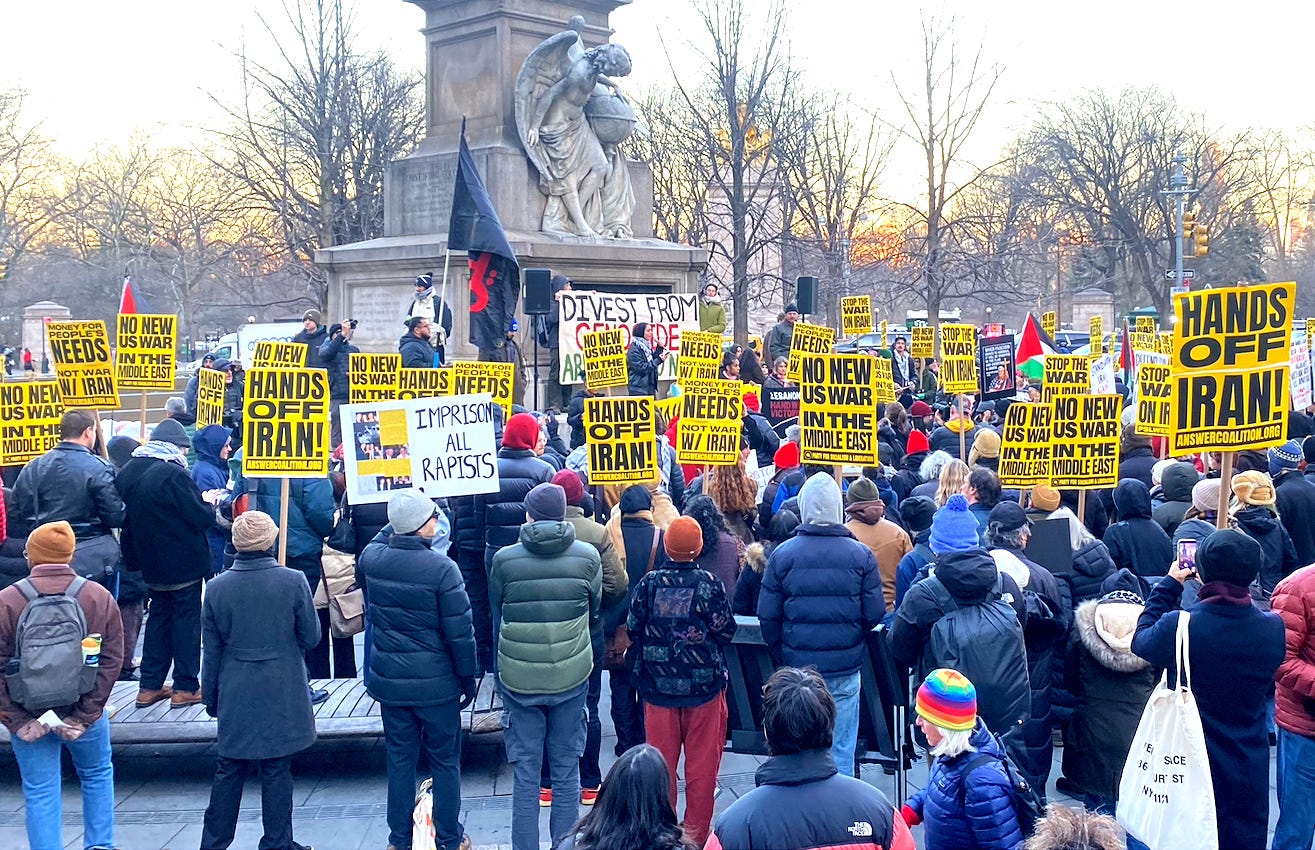
Across the street from the obsidian-black Trump Tower in New York City, hundreds of protestors gathered yesterday in front of a banner that read “Stop the War on Iran: Donald Trump is a War Criminal.”
Seniors sat on stone benches and young women stood with children in their arms. They were among the crowd listening with palpable distress as the activist with the microphone detailed the latest horrors of the United States and Israel’s joint assault on Iran and Lebanon—a war of choice which has already claimed over 700 lives, most notably Supreme Leader Ayatollah Ali Khamanei, as well as at least six U.S. soldiers. Soon the crowd began chanting: “Money for jobs and education, not for war and occupation.”
It was one of 70 demonstrations across the country, part of an emergency day of action organized by The ANSWER Coalition and a score of progressive groups. The National Iranian-American Council was also a co-sponsor, indicating Iranian opposition to foreign intervention at a time of significant instability in the nation.
Those who attended the past year’s No Kings protests would recognize the fervent anger expressed yesterday. But many demonstrators also voiced heightened panic and deep fear—fear of tacitly supporting the bloodshed with tax dollars Congress has so far failed to cut from Trump’s resources for war, of living under a regime’s expanding conflicts all over the globe and of retaliation at home. A new Washington Post poll found that three quarters of Americans across the political spectrum are concerned about a full-scale war and 52 percent oppose the initial strikes.
The clear conviction of these ordinary people, many of whom came straight from work and school to participate, formed a sharp contrast with members of Congress who have been reluctant to say whether they will support the War Powers Resolution of Reps. Ro Khanna and Thomas Massie. Several demonstrators expressed frustration with elected officials, Democrats and Republicans alike, for failing to check Trump’s power.
Despite the sharpness of their criticisms, difficult questions remain: Where does it end? What can be done? And how will Americans live with themselves if their demands go unanswered?
”Grow a goddamn spine”
Sarah, a 29-year-old copywriter at a technology company, couldn’t stand seeing more pictures of dead children on social media. Since Saturday, multiple images of the strike on a girl’s elementary school in southern Iran have been posted online as the state’s official death toll reaches 175. “It’s 2026. We’re going on three years, at least, of seeing [such images] on our feeds every day,” Sarah said. “There’s only so many times you can put it to the back of your head and not do anything.”
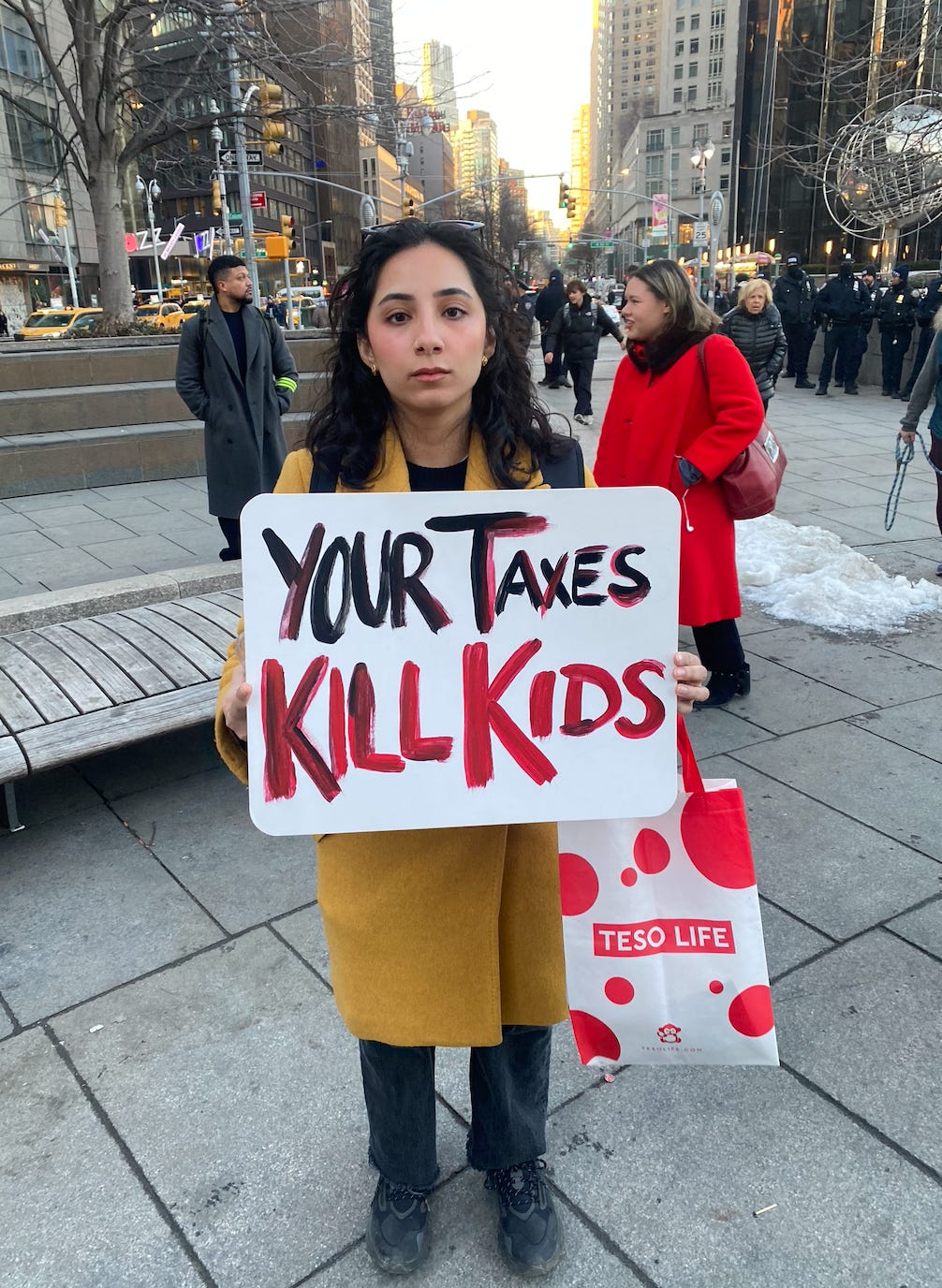
That heightened distress was echoed by John, 49, who works in advertising. “I feel like the mood today is rising,” he said. “People are getting sick and tired of it. We really need to stop it, Trump mainly, but also U.S. imperialism.” John lives in New Rochelle, a 35-minute train ride from the city, but has come to the city in recent months for similar demonstrations opposing U.S. involvement in Palestine, Venezuela and Cuba. Those efforts have come at a cost both at home and abroad, with the Iran conflict already reshaping American alliances. John’s message for Congress: “If you want to keep up the charade that we’re a democratic republic, then we need to end this war now.”
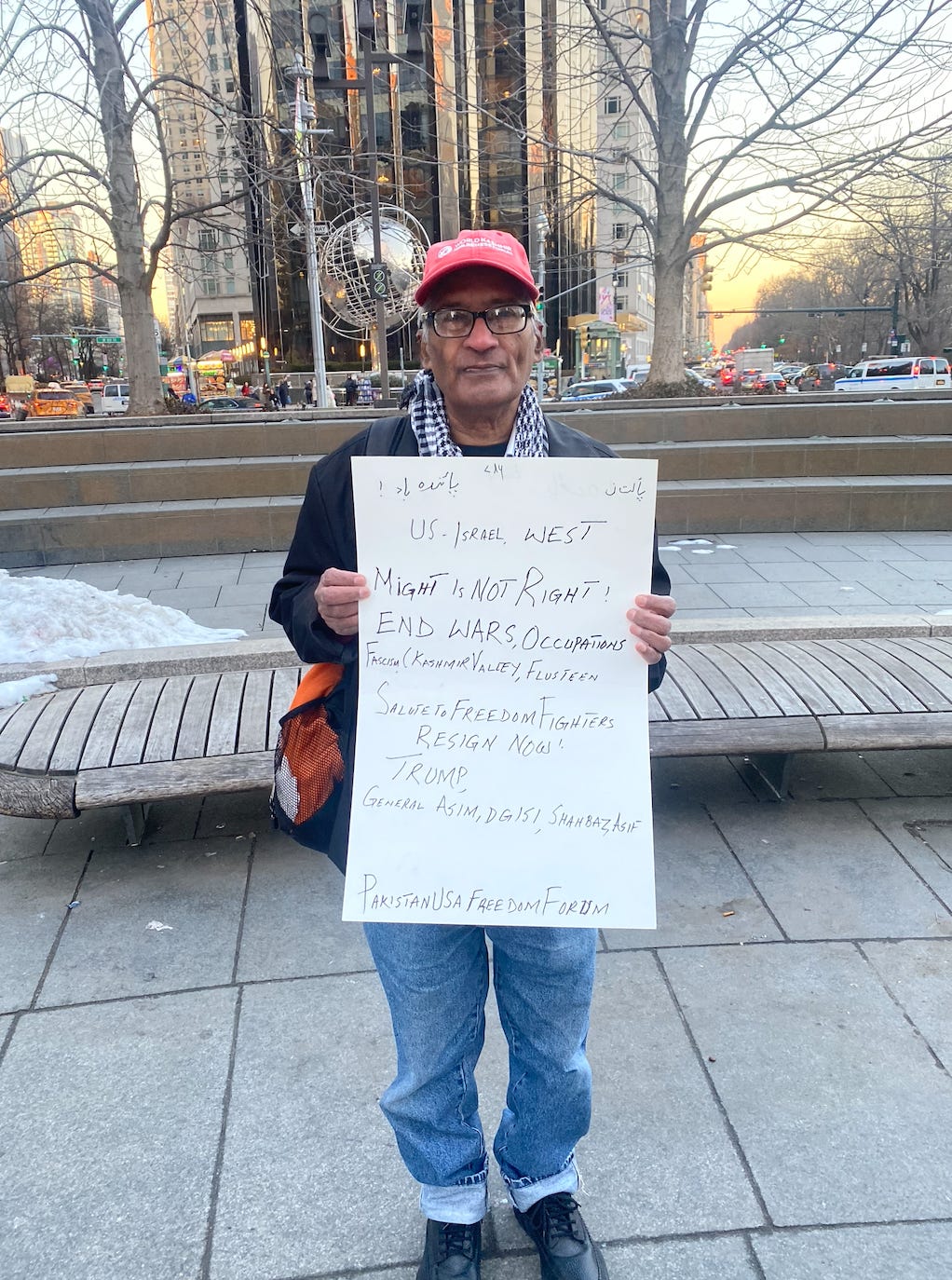
For Shahid Comrade, a Pakistani-American activist, the collapse of the traditional international order has felt deeply personal. “I’m here for peace,” Comrade said. He pointed to army chief Asim Munir, who observers say has become the de facto leader of Pakistan thanks to Trump. At a Mar-a-Lago event last December, Trump referred to Munir as “my favorite field Marshall,” lauding him as “a great fighter,” “a very important guy,” and an “exceptional human being.”
Comrade doesn’t see it that way. “This is regime change,” Comrade said. “He’s unelected. At this moment in Pakistan there are thousands of people in jail. There’s no freedom of the press in Pakistan. Why? Because of the U.S. state department.” But Comrade’s biggest concern was the possibility of Trump dragging the international community into a third world war. “It’s very sad that we chose this guy who was a man of the bankruptcy,” he said, “and now I think he is going to make the whole world bankrupt because of the conflict.”
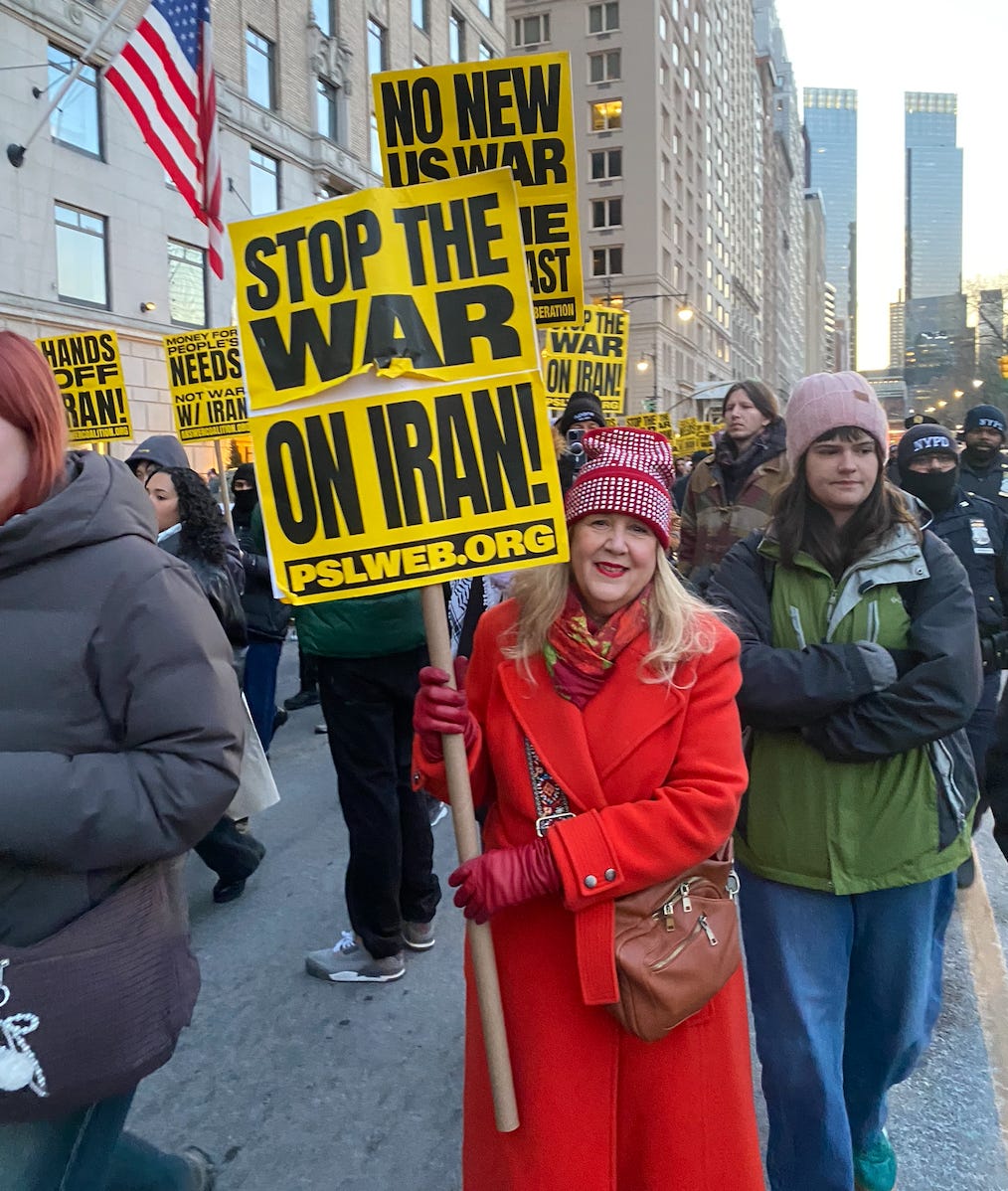
Organizers addressed the crowd for about an hour before leading a march along Central Park South heading east toward 5th Avenue. As she marched, Gwen Goodwin, a previous candidate for City Council and Public Advocate, noticed the American flag mounted at the Marriott hotel. She laughed with dismay at the sight of it. Goodwin applauded the young people who helped organize the protest, noting that they seemed somewhat sharper now than at No Kings. She attributed this to their realization that, like Vietnam veterans, they too could be forced to fight in a war they opposed. Of the impact of war on the human psyche, she said this:
My dad died in September. He was 102. He jumped out of a burning airplane twice in World War II. He was a tail gunner. And you know what? That war haunted him to his death bed. That is what he was seeing when he was dying, those images, OK. So this is serious business, going to war. And we have no right to appease the ruling class anymore. They don’t want to talk about what’s in our face. It’s the Epstein files. It’s the corrosiveness of that group, and that small group is exactly who’s bringing us to war today, that’s why we’re doing it. So we the people who have to fight it have to say to hell with you, we’re not going to do it.
But besides speaking out and engaging in protest, how should that be done exactly? Calls are increasing for Congress to immediately reconvene and take up the War Powers Resolution. But even if the resolution were brought to the floor, it’s not clear that it would pass or reign in Trump if it did.
Not all Democrats oppose Trump’s unilateral actions. Rep. Josh Gottheimer of New Jersey said he would oppose the Khanna-Massie resolution as it would take away Trump’s “flexibility.” Gottheimer is not alone. Aída Chávez, former D.C. correspondent for The Nation, reported last week that minority leaders Sen. Chuck Schumer and Rep. Hakeem Jeffries “deliberately inflated projections of opposition to the bipartisan measure—warning of 20 to 40 Democratic defections—as part of a broader effort to dampen momentum and prevent the Iran war powers vote from advancing.” They may have done so because of their own support for regime change—Schumer at least has only criticized Trump for failing to make a case for the war—or out of a misguided attempt to protect the party in the upcoming midterms.
Khanna himself only gave the resolution a 40 to 60 percent chance of advancing out of the House this week, according to NPR. “It depends if we can keep several Democrats in line,” Khanna said. “But I believe that this is a disastrous vote for any Democrat—to vote for Donald Trump’s war in the Middle East.”
“Unscrupulous, immoral leaders”
The path forward is not quick. There’s no reason to assume Trump would take seriously a War Powers Resolution, if it does pass. And even if principled progressives take control of the House and Senate in the midterm elections, they wouldn’t be sworn in until next January. The question of what to do now becomes a moral one.
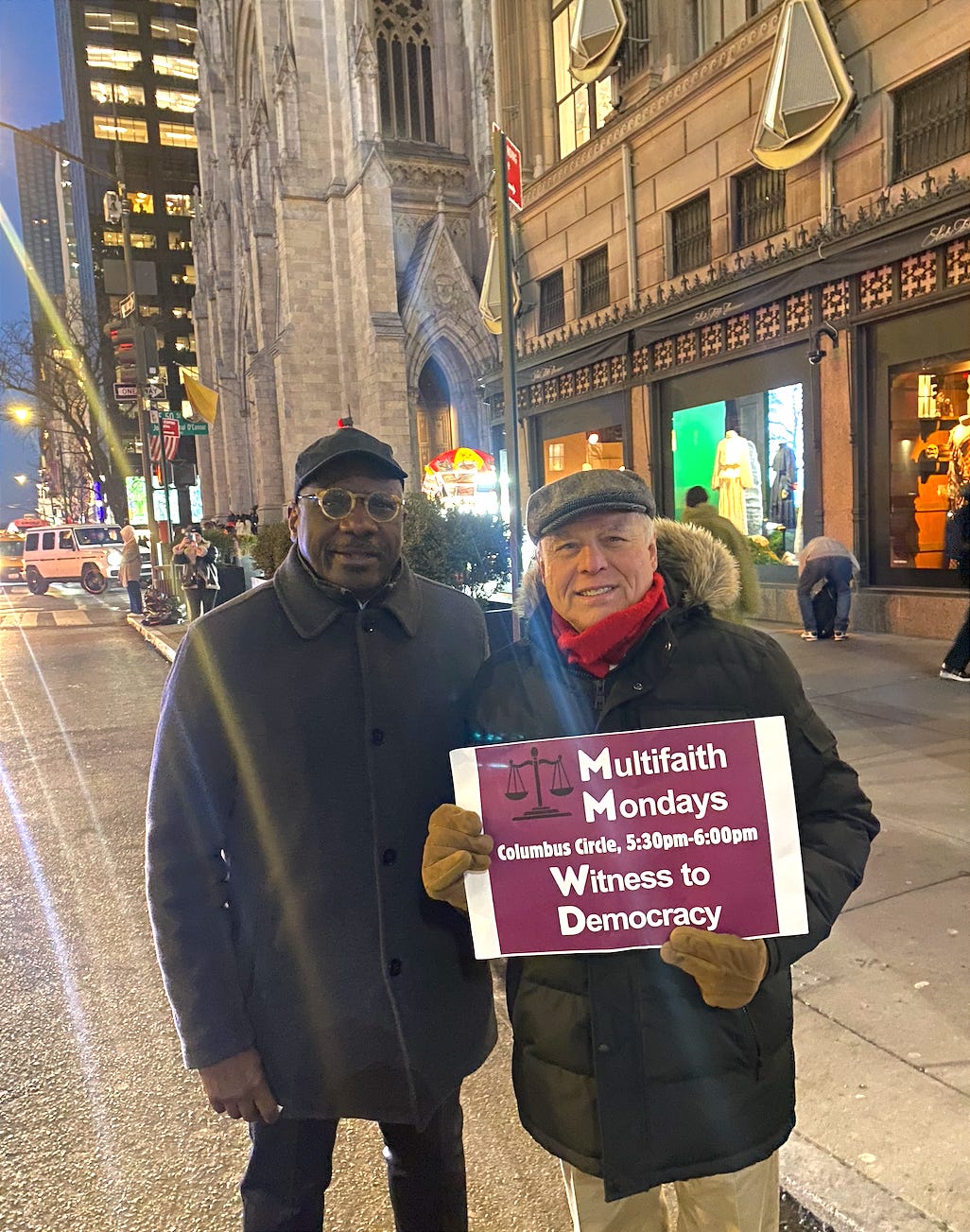
Rev. Frederick A. Davie and Fr. James DiLuzio were on the way to their weekly interfaith gathering when they heard about the protest. Davie, a Presbyterian minister, is the Senior Executive Vice President for Public Theology and Civic Engagement at Union Theological Seminary in Manhattan. Asked why they decided to join, Davie said, “I do this out of my faith. I do it because I care about people and people’s lives and their freedom. I don’t want to see people exploited for the sake of unscrupulous, immoral leaders like Donald Trump and like Benjamin Netanyahu.” He continued:
I’m glad that the Ayatollah is gone. I have a really close friend who is Iranian born, a U.S. citizen who was very happy with this war. But I don’t trust Trump, I don’t trust the people around him, I don’t trust Pete Hegseth, and I don’t trust them to execute a war at all, much less this one. So I’m here to simply protest the fact that they have entered into this without any clear objectives, there’s no sense of what the end game is for them.
If you ask me, I suspect it’s like Venezuela and that if he can cut a deal around oil access with whoever remains in the leadership in Iran, he’ll cut that deal and the people in Iran will be just as repressed after that deal as they are now. That’s the case in Venezuela. You don’t see any real civil liberties for the people in Venezuela after he cut his deal with that leadership for oil and I think the same will be done in Iran.
Both Davie and DiLuzio, a Roman Catholic priest affiliated with the Paulist Associates, stressed that politics and activism should be rooted in the universality of human rights. DiLuzio said Congress should set political agendas aside, remember our common humanity and put “those values into practice [with] every piece of legislation that you’re working on.” Davie had more urgent advice: “Stay strong and oppose this kind of abuse of power. Support the people of Iran to find their freedom. But following Donald Trump is not the way to do it.”
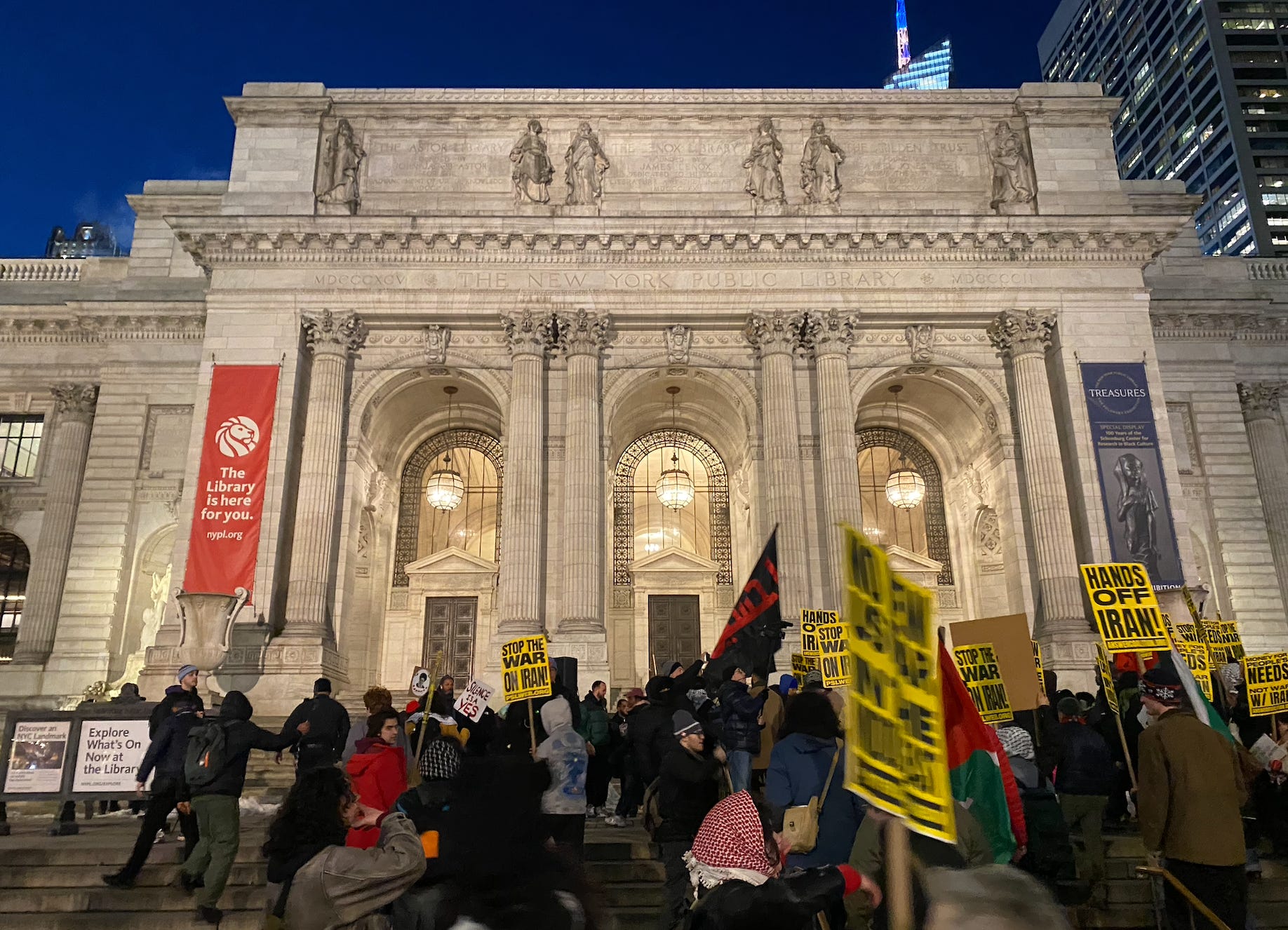
The march ended on the steps of the historic New York Public Library, where the crowd gathered for a final round of hoarse chants as the light faded over Fifth Avenue. People stood in small clusters, some checking their phones, some talking with strangers they’d just spent two hours marching beside. The mood was tired and unresolved. Nobody was claiming victory. The strikes were ongoing, the resolution remained stalled, and most of these people had work or school in the morning. But they had come, and I suspect many will come again in the days ahead.
Please consider becoming a paid subscriber for $50 a year or just $5 a month, if you’re not already. This helps sustain and expand the independent journalism of America, America, keep nearly all the content free for everyone and give you full access to the comments sections.
My heart weeps. This is the umpteenth unjust, costly, immoral and idiotic war I've been forced to watch during my lifetime. When will enough of us stand up and refuse to cooperate with all this?
This! On top of everything else! It has to stop! RELEASE ALL OF THE EPSTEIN FILES, and let’s get this over with!!!!