

Elect a clown, expect a circus.
The truth of this proverb was on painful display this weekend in Washington, D.C., courtesy of a deeply unwell man who spits on our history, glorifies violence and sows hatred.
He turned our White House grounds into a gross commercial venue for violent cage fights, adding fresh evidence that his malignancy knows no bottom.
It’s hard to overstate what a perverse irony it is—in this, the 250th anniversary of our nation’s founding—that such a man was returned to the presidency to accelerate America’s decline while enriching himself.
But there on the South Lawn—with the White House bathed in blue in the background—cage fighters were beating each other up on a platform advertising Bud Light, online betting and Monster Energy drinks. These fighters were seen on camera doing their preparations from inside the White House, while nauseating sycophants like Meta’s Mark Zuckerburg and House Speaker Mike Johnson cheered from the audience.
This is the kind of demoralizing spectacle Donald Trump wanted for his 80th birthday—lying that it has anything to do with the 250th celebration of American independence.
We can take some solace in knowing that just 16 percent of Americans find such an event appropriate at our White House. Still, the sight of the White House in the Paramount+ streaming was enough to make me cry.
Yet I’d like to focus here not on this sickening show, but on what happened Friday night at our sacred Lincoln Memorial. The disgrace and dishonor that took place there should not be forgotten—and it should remind us why this memorial is such a meaningful part of our nation’s history.
First, what happened:
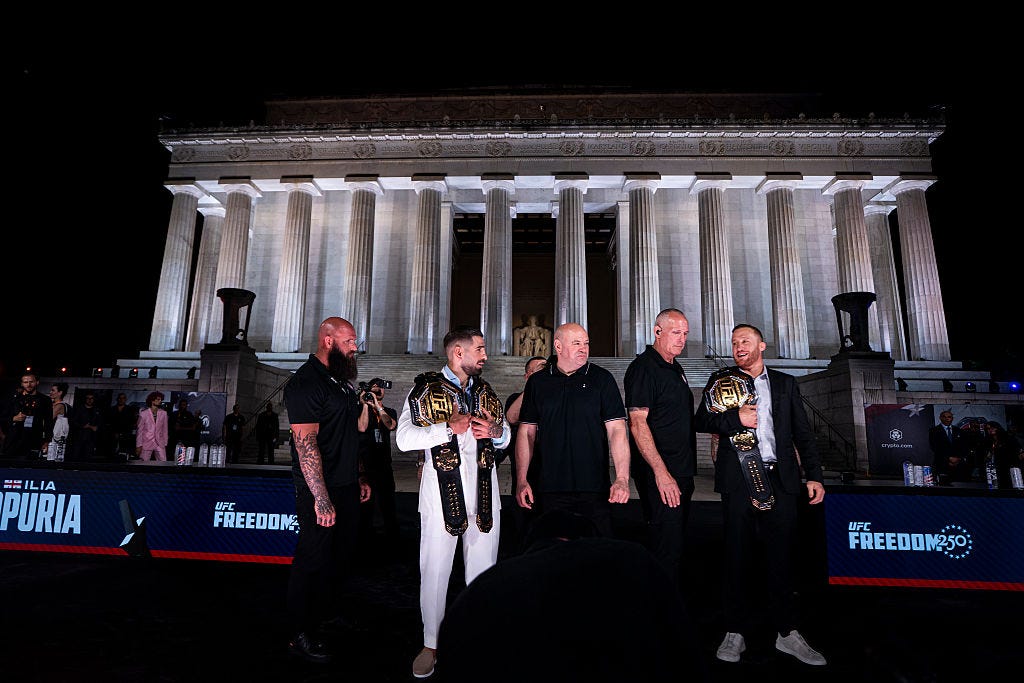
The cage fighters, part of the Ultimate Fighting Championship (UFC), descended the steps of the Lincoln Memorial with our greatest president’s marble statue in the background.
And they descended for a press conference—which included shoving and trading insults—between the two columns of the Armed Forces Full Honor Cordon. These are uniformed soldiers deployed to honor heads of state, other visiting dignitaries, top government officials or fallen military heroes.
This respected corps is not meant to honor bloody cage fighters.
But what made this display particularly vile was the choice of venue. The Lincoln Memorial was completed and dedicated in 1922 when Warren G. Harding was president, just 57 years after Abraham Lincoln’s assassination and the end of the Civil War.
Those tragedies were not just distant memories. From today’s perspective, that would be equivalent to looking back to 1969. (I suspect many of older readers would say that they remember well that year when American astronauts landed on the moon.)
President Harding’s long dedication showed deep reverence for the fallen president, including this:
In every moment of peril, in every hour of discouragement, whenever the clouds gather, there is the image of Lincoln to rivet our hopes and to renew our faith. Whenever there is a glow of triumph over national achievement, there comes the reminder that but for Lincoln’s heroic and unalterable faith in the Union, these triumphs could not have been.
Harding’s words are about national unity, about hope, about faith in our democratic experiment. He also quoted from Lincoln’s first inaugural address in 1861, including its profound closing sentences, delivered at a time of rising anxiety over secession and the possibility of war:
I am loath to close. We are not enemies, but friends. We must not be enemies. Though passion may have strained, it must not break our bonds of affection. The mystic chords of memory, stretching from every battlefield and patriot grave, to every living heart and hearthstone, all over this broad land, will yet swell the chorus of the union, when again touched, as they surely will be, by the better angels of our nature.
But Lincoln’s “appeal was in vain,” Harding noted, as Confederate forces attacked Fort Sumter in South Carolina just five weeks later, unleashing what Harding described as “a baptism in blood.”
But this memorial was not intended to dwell on war and bloodshed, but on the greatness of a man who saved the union. Said Harding:
His faith was inspiring, his resolution commanding, his sympathy reassuring, his simplicity enlisting, his patience unfailing…His was a leadership for a great crisis, made loftier because of the inherent righteousness of his cause and the sublimity of his own faith…Not only was our nation given a new birth of freedom, but democracy was given a new sanction.
Etched on the walls of the Lincoln Memorial is the text of both the Gettysburg Address—“of the people, by the people and for the people”—and Lincoln’s second inaugural address delivered the month before the war’s end and his own death.
Despite the growing number of war dead that would eventually climb to some 700,000 Americans, despite the deep and lingering animosity between the Union and the Confederacy prepared to destroy the country to hold onto the institution of slavery—tragic echoes of which continue to haunt our lives today—Lincoln found it in his heart to seek unity and forgiveness.
His closing sentence included these rightfully famous words: “With malice toward none, with charity for all, with firmness in the right as God gives us to see the right, let us strive on to finish the work we are in, to bind up the nation's wounds.”
In hindsight, we can argue about the wisdom of encouraging “malice toward none, with charity for all,” especially as Reconstruction and the righteous believers in the Lost Cause mythology continued to perpetrate racial hatred and violence. But we cannot deny Lincoln’s hunger for compassion and unity or doubt why it represented real leadership in the wake of America’s bloodiest war.
On the steps of the Lincoln Memorial Friday night, the American UFC cage fighter Justin Gaethje said to the Georgian-Spanish fighter Ilia Topuria after being shoved, “Look where we're at, look at this beautiful view and you want to act like an animal?”
It was exactly the kind of demonizing remark that birthday boy Trump would enjoy hearing, especially in a place like that. And what could please him more than to dishonor and disgrace the sacred monument of the great American president who understood the meaning of higher purpose and sacrificed his life to the cause of freedom?
There may be a clown leading a circus. These may be perverse days when it’s awfully hard to celebrate the founding of America. But in 140 days, on Nov. 3, we have the opportunity to stand up to this sickness and corruption and accelerate the necessary process of curtailing this hateful regime’s power.
Please consider becoming a paid subscriber for $50 a year or just $5 a month, if you’re not already. This helps sustain and expand the work of America, America, keep nearly all the content free for everyone and give you full access to the comments sections.
Beautiful essay. Perfectly encapsulated my feelings. I don’t need to say anything more.
Couldn’t sleep over this deranged weekend debacle…but your article has some beautiful historical moments Steven.
The contrasts between these heartfelt words by Lincoln - and the antics of the creature now leading the Caligula clown brigade is shocking.
Here is this lovely helpful excerpt you included:
“The mystic chords of memory,
stretching from every battlefield and patriot grave,
to every living heart and hearthstone, all over this broad land,
will yet swell the chorus of the union,
when again touched, as they surely will be,
by the better angels of our nature.”
I hold on to these words.
Thank you