

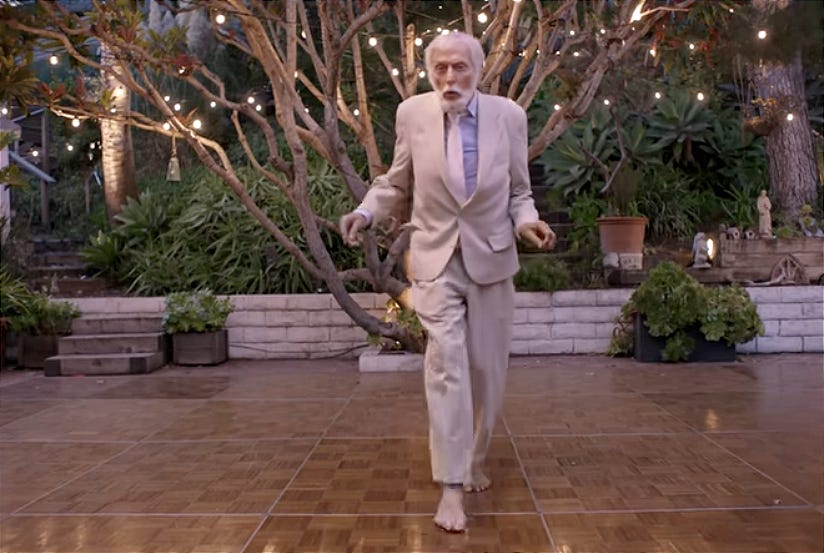
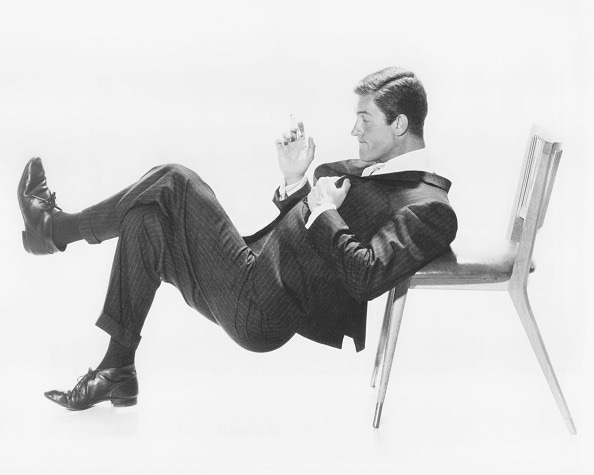
I’ve always been a fan of Dick Van Dyke. I think it’s because of his unusually positive attitude that beams through all of his work. As a small child, I was drawn to his character in The Dick Van Dyke Show, Rob Petrie, a TV writer for a comedy show. Yes, he was funny. (I mean, the flexible ways he moved his body!) Yes, he had a lovely, charming wife in Mary Tyler Moore. Yes, I was intrigued by his interplay with his fellow writers as they created a show. But most of all, I think, it was because he modeled a version of an adult male that was warm, creative and seemed to take a lighter touch with life. Oh, I thought, men can be like that.
Dick Van Dyke turned 100 today, a milestone which is always remarkable. But it’s particularly uplifting—and illuminating—that the guy who made it to 100 is one of the good ones. I don’t know if you’ve seen press accounts of Van Dyke in recent years, but they usually emphasize how he continues to sing, dance and laugh. It surely helps that he appears to have a happy marriage and is surrounded by family and friends. Any time I’ve seen him on camera, his light shines through. (If you haven’t seen the charming video Van Dyke filmed last year with Coldplay’s Chris Martin for the song “All My Love,” do yourself a favor and check it out. It was released on Van Dyke’s 99th birthday. You can also see a new PBS American Masters documentary about him: “Starring Dick Van Dyke.”)
Time magazine recently interviewed Stacy Andersen, a behavioral neuroscientist at Boston University and co-director of the New England Centenarian Study, the world’s largest study of centenarians and their families. Part of that conversation focused on the genetics of longevity, which Anderson says only account for about 25 percent of why people live longer, while behavioral choices are key determinants for the rest. These include maintaining a healthy weight, eating well, getting moderate activity daily, etc. “Those are things that can help everyone live 10 years longer,” Anderson says.
While she says genetics play a much bigger role for those who live to 100 or more—typically delaying or avoiding many of the chronic age-related illnesses that can shorten lives—the centenarians typically don’t smoke, eat a varied diet, are social, feel purposeful and find joy in their everyday lives. For those last points, the Japanese talk about ikigai, or that which brings value and joy to life.
“I would say that across studies it really seems like centenarians have very good psychological well-being,” Anderson says, adding:
They tend to score low in neuroticism. They don’t worry too much about bad things that happen. They’re able to deal with them and move on. They also score high in extraversion. They’re willing to try new things. They tend to be very outgoing, which I think helps them make new social connections as their peers pass away. They’re out doing things and meeting new people, and that helps their social networks. It also helps keep their brains strong.
We are living in an extraordinarily stressful moment in America. We are confronted by transgressions and horrors from those in power that most of us would have never expected to witness. The onslaught of bad news, fueled by an extreme malignant narcissist and his enablers, takes a toll. There are days when we all need to take a breath and do something else to maintain our mental health. In my case, that includes taking a long walk with my dog, going to the gym, listening to music, watching a great TV series or a well-crafted film, or just hanging out and having laughs with my wife and family. But I also know that—even on the days when I’m feeling overwhelmed by the political realities—my ikigai involves my obligation to try and make sense of our political reality while remaining optimistic that we’ll see our way through this dark period.
Honestly, I don’t know if I’d want to live to 100. I do know that there is a ton more that I want to do with my life before I’m done. I suspect the answer to the question revolves around how healthy I would be if I lived that long. But what I do know is that, once again, Dick Van Dyke is offering a model for living a good life, which includes laughter, loving, positivity, purpose and staying physically and socially active.
So what about you? Do you want to live to 100? Do you know people who’ve lived that long? Are there choices that you have made or want to make in pursuit of longevity? Perhaps you’d like to share a story of someone you know that models healthy, life-extending behavior.
As always, I look forward to reading your thoughts and the opportunity of this community to learn from each other. Please do be respectful in your remarks. Trolling will not be tolerated.
Becoming a paid subscriber to America, America—for $50 a year or just $5 a month—helps sustain our work, keeps nearly all the content free for everyone and gives you full access to our dynamic community conversations. It also represents your commitment to independent journalism.
My mom has Dick Van Dyke beat by two years. 102 and still living independently.
To be frank, with the direction the world seems to be going, I would not want to be here until I’m 100. Certainly not in any form of a Trumpism world. But also, we already cannot humanely or effectively take care of our elderly population with empathy and compassion.