

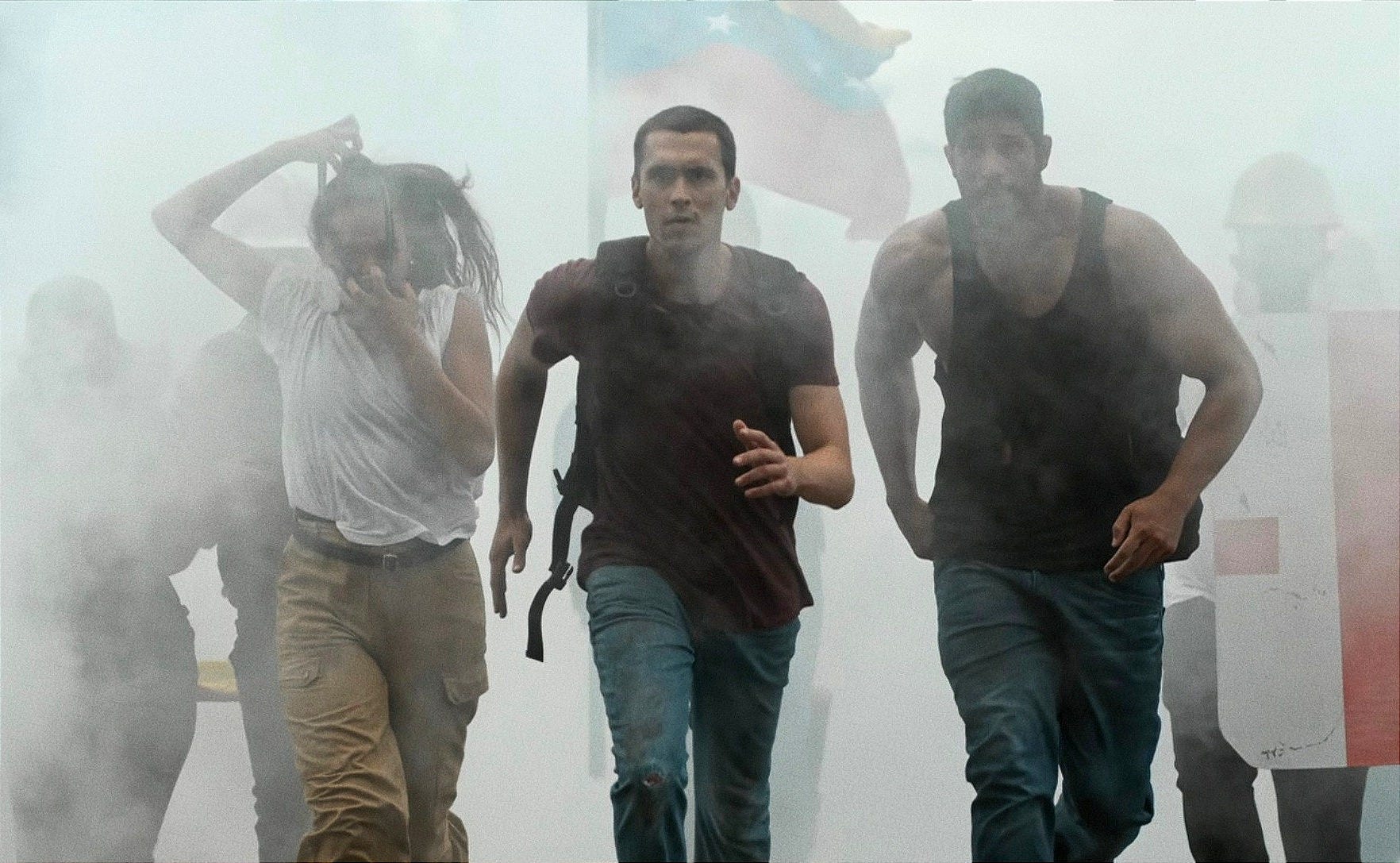
Editor’s Note: This weekend, we’re reflecting on a movie from a few years ago for its perceptive look at the Venezuelan humanitarian crisis and its salient portrayal of protest and resilience. Simón (2023) is streaming on Netflix and is available on Video on Demand.
“What about the international community?” This is what a hopeful young revolutionary asks her small group of compatriots. The entire room laughs in derision.
“Wait for someone else?” responds their leader, Simón. “No one else will get us out of this mess.”
This is the first but not the last time someone will emphasize the role Venezuelans must have in their own liberation in Simón. Writer-director Diego Vicentini’s debut film, Simón, is a canny exploration of the aftermath of political resistance. Simón is a university student arrested for his participation in protests against the Maduro regime. After surviving an utterly brutal period of imprisonment and torture, he flees to Miami and wrestles with pressure to return to his home country.
Despite the protestors’ skepticism of international involvement, Simón is a film clearly designed for a global audience. Christian McGaffney is a compelling lead with Hollywood charm, and his bilingual, quietly heroic Simón is a perfect liaison for an audience that might not be Venezuelan or Spanish-speaking. His intelligence and sensitivity are so immediately appealing that it’s no wonder Melissa, a Florida-born gringa volunteering in a local aid group, quickly becomes his friend and legal advocate as he navigates the American immigration system.
Simón states plainly the facts of Venezuela’s crisis: This is a nation overrun with poverty and civil rights abuses because of the Maduro regime. But it’s not Maduro that receives the brunt of the student protesters’ ire. They are most disgusted by Maduro’s army: their fellow Venezuelans who have turned on their countrymen with shocking, vicious cruelty.
Donald Trump’s recent actions in Venezuela are hardly unprecedented. The long history of American intervention in the Global South is so well-known that even Marjorie Taylor Greene, hardly a history buff, has brought it up. But Simón makes an essential point early on: Maduro is only one piece of the crisis. In one of the film’s most chilling scenes, the terrifying head prison guard explains the larger machinery at play.
“Do you think if you overthrow that fool, things will change?” he asks, then laughs in Simón’s face. “Nothing will change.”
Simón premiered to international acclaim in 2023, and it’s worth a revisit not just because of that critical attention or because it’s a rare and honest snapshot of Venezuelan life under Maduro. It’s also a compelling saga of protest—and, most importantly, when protest ends. Of what happens when a militarized government takes total control of a state and gives people nowhere to turn. Of the demise of free speech, of freedom of the press, of any semblance of truth.
Simón and his fellow prisoners are accused of terrorism for their peaceful protests and threatened with a lifetime of brutal imprisonment. It’s of no importance to their captors that one of the prisoners says he’s never even been to a protest or been politically active. The tyrannical rule sees citizens as enemy combatants and strives to squash them with poverty, starvation and violence.
The film is a raw portrait of Venezuela, but it’s also a warning to the rest of the world about absolutism—especially for countries flirting with authoritarian rule. We’ve seen this week, in the horrific murder of Renee Nicole Good in Minneapolis by an empowered ICE agent, how easy it is for federal authority to abandon the rule of law and human decency. Despite multiple videos and eye witnesses clearly identifying the armed ICE agent as the aggressor, Trump and his Republican cronies have absolved her killer and excused her death. This administration continues to tell us that what we see, what we know and what we’ve experienced are not true. There was no January 6 coup, they say. Greenland has always been America’s property. ICE is protecting us, not threatening our safety and lives.
Though Simón takes several dramatic turns, it doesn’t imagine foreign intervention. Even by moviemaking standards, the United States sweeping in to take over the country by force was too absurd. The film takes a more microcosmic look, following Simón as an idealized everyman struggling inside the many hostilities of American culture. He attempts to send insulin back home to a diabetic friend, only to discover the prohibitive cost and failed infrastructure of the American healthcare system. He pays $4 an hour for WiFi to research asylum status, navigating a bureaucracy in his non-native language.
It’s worth noting that when the film came out in 2023, Venezuelan nationals in the United States like Simón were granted Temporary Protected Status, which allowed them to apply for work permits and protected them from deportation. These are privileges not typically afforded to all immigrants. In November of 2025, Kristi Noem ended this protection for Venezuelans, and many other immigrants from countries experiencing civil war and conflict.
In an early scene, Simón returns to the bare apartment that a friend has allowed him to crash in temporarily. Exhausted from a long day, he lays down on his air mattress only to have the air slowly leak from under him until he’s flat on the floor. Throughout the movie, any glimmer of respite Simón wins is quickly, imperceptibly, snatched from him.
For many Venezuelans, Maduro’s removal is a long-awaited blessing. But the air has already started coming out of the mattress. Trump has announced his desire to maintain U.S. control of the country for years—presumably for as long as he can profit from the nation’s oil reserves. But if we can follow the example set by Simón and his revolutionaries, every movement starts with people on the streets. It’s a reminder: Our fate is up to us.
Have you seen Simón? What other films, domestic and international, speak saliently about the importance of citizen protest? What’s next on your watchlist?
Please consider becoming a paid subscriber to America, America for $50 a year or just $5 a month, if you’re not already. It helps sustain our growing work, keeps nearly all the content free for everyone and gives you full access to our dynamic community conversations. It also represents your commitment to independent journalism.

I want to note that the name “Simón” is a symbol of freedom. Venezuela’s official name in English is Bolivarian Republic of Venezuela. In Spanish República Bolivariana de Venezuela. Bolivarian to honor Simón Bolivar aka El Libertador, or the Liberator. Several countries view him as the hero who led them to freedom from Spain.
“The tyrannical rule sees citizens as enemy combatants and strives to squash … .”
It is frightening that this now describes our government AND a monetized philosophy in what were the most popular trainings for law enforcement in the US. The warrior ethos, the emphasis on willingness to kill as a requirement. David Grossman who was never in law enforcement touted his military credentials. His ‘institute’ was named Killology.
Perhaps we’ve forgotten that as it became public knowledge in the aftermath of George Floyd’s killing there was big outcry over PD trainings. Minneapolis banned the training & the FOP sued. Similar and other battles over training around the country.
The institute has changed its name and focus but not before other trainers, many state and local PDs, incorporated the philosophy into their training and behavior — with white nationalist cultural components.
DHS has revived this warrior ethos in law enforcement with heavy emphasis on white nationalism.
The Unbearable Lightness of Being comes to mind, for films depicting protest. It’s been many years since I saw the film but in my memory the uprising swept its protagonists out of the personal into a collective awareness. That, to me, is the challenge today. Faced with a threat, people cope by denial, insisting that their worlds are unchanged and that the threat isn’t real. Fascists count on that, to give them time to consolidate and install military power domestically. Uprisings after the military dictatorship is firmly in place are inevitably more deadly than earlier protest.
It’s telling that the Episcopalian bishop counselled his ministers to prepare to be martyred. Some people do understand the stakes. Too few, unfortunately.