

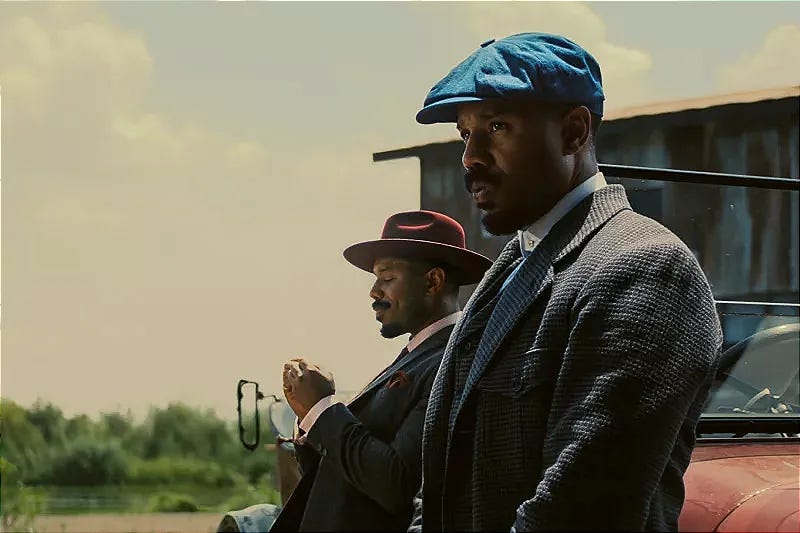
Sinners has already made history. Not only was it nominated for a record-breaking 16 Academy Awards, making it the most nominated movie of all time, many of those nominations came with their own distinctions. Ryan Coogler is the seventh Black director to be nominated for Best Director (none have won). And Autumn Durald Arkapaw is the fourth woman and first woman of color nominated for cinematography. Whether you think Sinners is the best movie of 2025, or whether it will take home Oscars for any of these 16 nominations tonight, it’s arguably the most talked-about movie of the year. And at the heart of both the film itself and the surrounding discourse is the question of who owns Black art, and who gets to profit from it.
Set in 1930s Mississippi, Sinners follows twin brothers, Smoke and Stack (both played by Oscar-nominated Michael B. Jordan), who have returned from Chicago to set up a juke joint in their hometown. Their dealings with Chicagoland gangs have put money in their pockets, but the twins dissuade their young musician cousin, Sammie (Miles Caton), from idealizing the urban north. “Chicago ain’t nothing but Mississippi with tall buildings instead of plantations,” Smoke says, before Stack continues, “Might as well deal with the devil we know.”
But it’s a devil they don’t know that provides Sinners’ horror twist. Remmick, the leader of a trio of white strangers that show up at the joint, is not like anyone the twins have encountered. He’s not a hapless drifter in search of a good party as he first claims, but a vampire looking for more souls to join the ranks of his undead. Remmick has been lured by the sweet sound of Sammie’s blues playing. He believes that by turning Sammie, he’ll be able to reconnect to his lost ancestors.
Coogler puts an original spin on the vampire mythos: Though the vampires retain individual identities, they share a collective memory, adopting the languages and stories of anyone who has been turned into a vampire. As Remmick reveals his past, he proves to be not as different from these Black southerners as he first appears: he’s also a victim and survivor of colonial violence. In referencing a pre-Christian Ireland, he makes a convincing argument for a communal immortality free from oppressive power structures.
Even before Sinners premiered, multiple outlets and studio executives expressed skepticism about Warner Brothers’ deal with Coogler giving him eventual copyright ownership and creative control of the film—deals similar to ones made with writer-directors like Mel Gibson, Richard Linklater, Peter Jackson and Quentin Tarantino. The aphorism that Black people need to be twice as good to get half as much proves painfully true. Though Coogler has helmed two massively successful franchises (Black Panther, Creed) and generated well over $2 billion at the box office, studio executives were infuriated that Coogler insisted he retain ownership of his work. An anonymous executive called the deal “dangerous,” perhaps unaware that this word evokes a centuries-long racist history of fears around Black self-determination. It’s ironic that these executives vying for the rights to Sinners entirely missed the film’s themes about the necessity of Black artists protecting their creations.
Coogler, who also wrote the screenplay and successfully negotiated the right of final cut, obviously recognized the strength of his project. If Coogler has an avatar in the movie, it’s in Sammie. In the film’s most impressive sequence, a single tracking shot shows performers across African and Chinese diasporas appearing as Sammie plays guitar. From Chinese opera to Ivory Coast Zaouli dancers, from psychedelic funk guitarists to crip-walking B-boys, we are reminded of the cultural legacy Sammie has trained himself in. Like Coogler himself, Sammie possesses a talent he has honed and developed in the tradition of his artistic forebears, despite doubt and naysaying from the people and culture around him. And like Coogler, he has held onto a gift that outsiders—whether they’re Remmick or predatory studios—have tried to latch onto.
And as Annie (Oscar-nominated Wunmi Mosaku) reminds us, the bargain offered by Remmick and his gang is not a good one. Yes, becoming a vampire would offer earthly permanence to Sammie and his music. But it would mean sacrificing his artistic voice to a machine he’s ultimately only a cog in. And while Remmick’s promises of community and collectivism might sound utopian, it comes with a tacit acceptance of nonstop, brutal violence and the spiritual disconnect from the ancestral practices explicitly key to Sammie’s musicianship.
Though Sinners has plenty for a typical Oscar voter to enjoy—the period setting, meaty dual leading man parts, its devotion to blues and the arts in general—the movie is hardly typical Oscar bait. It’s also no wonder that many audiences and critics have seen the success of Sinners as a culture war victory in the second Trump administration: providing proof that, despite the best attempts of the American government, there is still a passionate interest in Black culture and experiences. In this culture war, Sinners has taken on a responsibility of representation and civic righteousness that feels deeply unfair to any movie.
Yes, it would be awfully nice if Sinners’ continued success meant a nail in the coffin for the Trump administration’s hostile agenda toward people of color and their heritage. But an administration that starts illegal wars, protects child predators and impoverishes struggling Americans to further enrich billionaires is not going to be stopped by a movie, no matter how many awards it receives and tickets it sells. Still, if there’s a message to be taken away from Sinners, it’s in Coogler’s potent messages about art and the eternal. The struggle is longer than any of our lives. Man might not last, but art does.
Sinners is a testament to the joy and danger of Black creativity and artistry, the success Black art can have and subsequently inspire. An award show might not change the country, but it does cement Sinners in a canon from which Black film has historically been excluded. And, win or lose, the movie reminds us that—even amidst nonstop remakes and dwindling attention spans—audiences still have an insatiable thirst for originality.
If you value independent journalism, we hope you will become a paid subscriber of America, America for $50 a year or just $5 a month. This helps sustain and expand the work, keep nearly all the content free for everyone and give you full access to the comments sections.

It was quite amazing... this 80yo Chicago gal loved the Buddy Guy piece at the end..brought back memories
It’s worth seeing the movie just to watch Buddy Guy - he’s a true legend.