

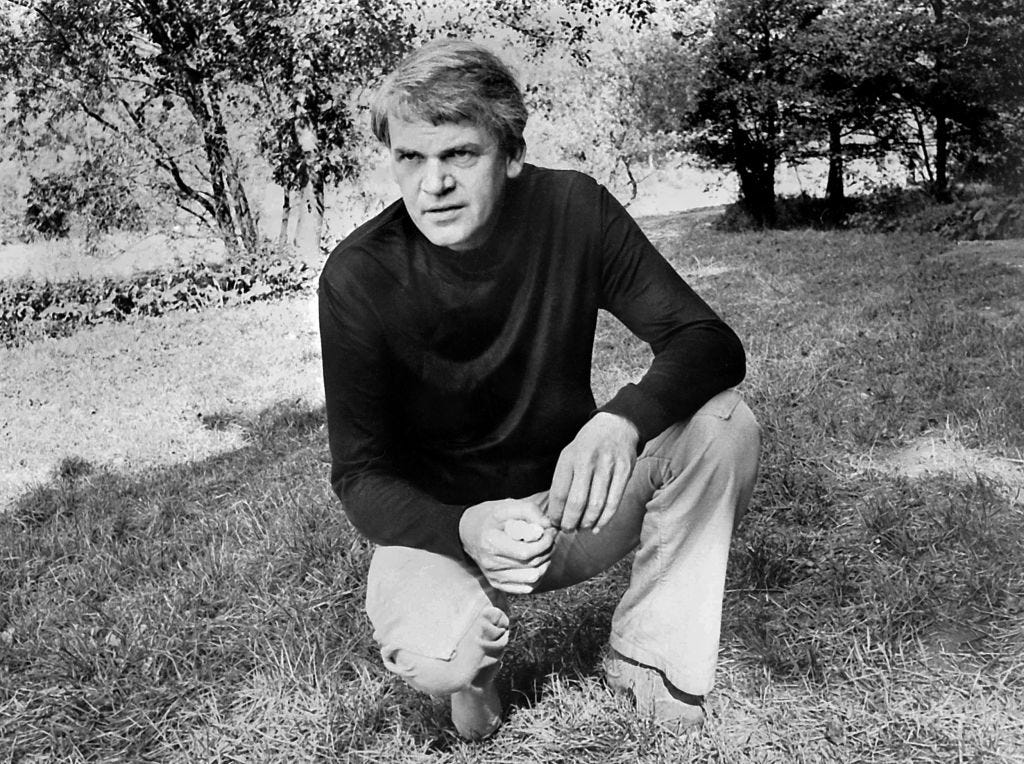
I want to share with you a short excerpt from novelist Philip Roth’s conversation with Milan Kundera, published in 1980 as an afterword in the great Czech writer’s novel, The Book of Laughter and Forgetting. Kundera—who became an émigré in France after his books were banned and he faced increasing political pressure—is one of my favorite writers. His explorations of totalitarian politics and freedom and the survival of personal identity are consistently heartbreaking and humorous.
This excerpt has been lingering in my mind because of its acute viewpoint and how it speaks to our own troubling moment. While not explicit, it draws on his own experience living through the Soviet invasion and takeover of Prague in August 1968, tragically ending the inspiring period of protest and political liberalization that year during Czechoslovakia’s Prague Spring.
Roth: Do you think the destruction of the world is coming soon?
Kundera: That depends on what you mean by the word ‘soon.’
Roth: Tomorrow or the day after.
Kundera: The feeling that the world is rushing to ruin is an ancient one.
Roth: So then we have nothing to worry about.
Kundera: On the contrary. If a fear has been present in the human mind for ages, there must be something to it.
There is a history of catastrophes that dates back many thousands of years, including epic natural disasters like fires and floods, earthquakes and hurricanes—biblical-scale events that created both trauma and survival mechanisms for earlier humans. It’s no wonder that a sense of the end of times is ingrained in our DNA and documented by bible writers.
But Kundera had a very specific experience resulting from Russia’s invasion and occupation that shaped his thinking. Here’s how he described it to Roth:
If someone had told me as a boy: One day you will see your nation vanish from the world, I would have considered it nonsense, something I couldn’t possibly imagine. A man knows he is mortal, but he takes it for granted that his nation possesses a kind of eternal life. But after the Russian invasion of 1968, every Czech was confronted with the thought that his nation could be quietly erased from Europe, just as over the past five decades 40 million Ukrainians have been quietly vanishing from the world without the world paying any heed...
I don’t know what the future holds for my nation. It is certain that the Russians will do everything they can to dissolve it gradually into their own civilization. Nobody knows whether they will succeed. But the possibility is here. And the sudden realization that such a possibility exists is enough to change one’s whole sense of life.
It is encouraging to note that nearly five decades on from this conversation, there is no longer a Soviet Union and the Czech Republic lives. But it’s a tragic fact that the civilization-killing mentality of the Soviet leadership has survived and prospered in Russia, thanks particularly to the murderous Vladimir Putin, who dreams of reconstituting that previous brutal empire and is bent on pursuing it.
And while Ukrainians continue to proudly and bravely fight in our day for their survival, a once-reliable supporter like the United States is now led by a heedless man who would welcome Ukraine “quietly vanishing from the world.” That man made his deranged impulses explicit last month when he threatened Iran like this: "a whole civilization will die tonight, never to be brought back again."
Closer to home, we are faced with our own ongoing threat to the survival of our democratic nation and to many good and decent people who inhabit it. It’s more than understandable if there are days when you wonder whether we are inescapably “rushing to ruin,” as Kundera put it. But I think it helps to know that our predicament is not a new one, but rather a condition that many humans before us have faced—and ultimately overcame.
Please consider becoming a paid subscriber for $50 a year or just $5 a month, if you’re not already. This helps sustain and expand the independent journalism of America, America, keep nearly all the content free for everyone and give you full access to the comments sections.
One more thing: You can read more about Kundera’s The Unbearable Lightness of Being and the Soviet invasion of Prague, written by me in the days after Russia’s invasion of Ukraine in February 2022. That essay is titled “The March of Evil.”
This is a great post, and a reminder of a great writer.
Thank you, Seven, for bringing into perspective what this country is going through today, viewed through the lens of struggles caused by the same kind of destructive force Milan Kundera writes about.
When I came to this country in the mid-80s, this was my question: How long will it take before the perfidious mentality of the Russian mafia seeps in and attempts to ruin the system that has been bringing opportunity and freedom to everyone?
The effects of this treacherous influence are now more visible than ever—finally out in the open, without doubt.
Thank you for pointing it out in such a clear and unambiguous way.
The history of ruthless greed trying to eradicate wisdom in order to advance its criminal agenda goes back at least to ancient China. What have we learned, other than that it is a recurring and continuous attempt to block the true light—that “intellectual light” you noticed in Finland?
I do have some answers, and they relate to the nature of human consciousness and our ability to cognize beyond the logical, linear mind. But in this note, I simply wanted to express my appreciation for your relentless, courageous, and beautiful work.
It helps a lot.