

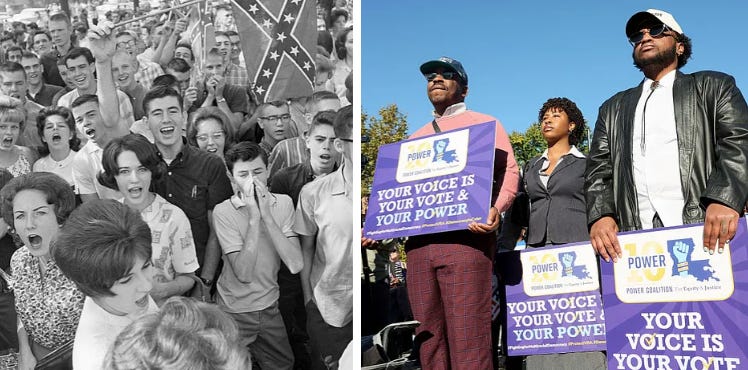
It’s been stunning to see the speed with which a number of Southern states have initiated redistricting efforts before the midterms to disenfranchise Black voters. Stunning, but not surprising. Stunning—and deeply saddening—because it vividly exposes the deep strain of racism that continues to poison America.
Following the Supreme Court’s 6 to 3 decision in Louisiana v. Callais last week—gutting the Voting Rights Act and its commitment to increasing racial equality in elections—Republican-led legislatures in Louisiana, Tennessee, Alabama, South Carolina and Florida have quickly pushed to redraw the maps in their states.
Yesterday, for example, Tennessee Republicans passed a new congressional map that would split Shelby County—where majority-Black Memphis resides—into three districts, including two districts that now extend some 200 miles. “Give me a break,” said State Sen. Jeff Yarbro of Nashville. “It’s the most blatant dilution of Black voting power since the height of Jim Crow.”
If this were simply a political maneuver by Republicans to hold onto power, that would be one thing. Of course, that’s the surface-level argument Donald Trump makes in support of a process that he excitedly and falsely claims could increase the number of GOP-dominated districts by more than 20 House seats. A more sober assessment: Redrawing majority-minority districts could add 12 House seats for the Republicans.
But this has to be understood in the context of Trump’s virulent racism and his regime’s ruthless push to undermine people of color, deny the racism inherent in America’s economic and political systems, and undercut efforts to right those historic wrongs.
That began in Trump’s second term with the vilification of any program or any language that recognized racism and sought to encourage diversity, equity and inclusion, a plan made more insidious by the denial of slavery’s reality and its bitter fruit dating back over 400 years. The effort to resurrect the monuments of Confederate traitors, for example—including statues and names of Army bases and naval ships—is part of this sickening strategy to rewrite history and deny obvious truths.
Again and again, there have been moments to confront this fundamental blight that continues to stain the promise of America, including the decision by northern representatives to not confront slavery in 1787 to ensure that southern states would commit to the signing of the U.S. Constitution.
The rampaging terrorism of the Ku Klux Klan in the late 1860s—a whirlwind of deadly violence and fear—sought to suppress Black voters after the passage of the 14th and 15th Amendments and the emergence of a Black electorate; it made clear the brutal opposition by many white Southerners to the rise of Black citizens, despite new federal laws seeking justice and inclusion, and thereby creating the hateful fuel for some 90 years of segregationist, white supremacist Jim Crow policies.
Over the last several years, the Economic Policy Institute has released a valuable series of reports examining the “economic underperformance” of Southern states titled “Rooted in racism and economic exploitation.” Here’s how the institute summarizes its overall mission: “to counter rising inequality, low wages and weak benefits for working people, slower economic growth, unacceptable employment conditions, and a widening racial wage gap.”
Consider a few of the findings from this series:
The share of prime-age workers (ages 25–54) who have a job is lower than the national average in most Southern states.
Median earnings in nine Southern states are among the lowest in the nation, even after adjusting for lower cost of living in the South.
Poverty rates in most Southern states are above the national average. In Louisiana and Mississippi, nearly 1 in 5 residents live in poverty.
The child poverty rate in the South is 20.9 percent—higher than in any other region.
These statistics reflect an anti-worker economic model whose signature policies are low wages, low taxes, few regulations on businesses, few labor protections, a weak safety net and vicious opposition to unions.
The institute’s report describes a Southern economic development model that serves the wealthy and business interests and denies shared prosperity with a strategy to “extract the labor of Black and brown Southerners as cheaply as possible.” The second of five parts documents the racism rooted in the model and seeks to confront “the enduring racial hierarchy in the South.” Among its findings:
From low wages to unfair tax policies to a weak safety net, the Southern economic development model ensures that businesses continue to have access to cheap Black labor even after the abolition of slavery.
A key component of the Southern economic development model is low wages. Twenty states still use the federal minimum wage of $7.25, and half of these states are in the South.
On top of struggling with low wages, many Southerners—particularly Black and brown Southerners—have trouble accessing unemployment insurance and other benefits, which are often inadequate.
Policymakers have worked to limit Southerners’ rights to unionize and bargain collectively since unions make it hard to keep wages low and benefits stingy.
Nearly four decades ago, I traveled over 4,000 miles in a dozen southern states and conducted over 150 interviews in an effort to understand not only the economic challenges of the region, but also the economic disparity between urban and rural areas. When I started, I had not specifically intended to focus on the issue of racism, but it became unavoidable the more I listened.
One story always sticks with me because it encapsulates the tragedy. I was talking to a white business development executive in Holmes County, Mississippi, one of the poorest counties in the poorest state in America.
We talked about how in the 1960s—after the Supreme Court’s 1954 Brown v. Board of Education ruling required school desegregation to address educational inequality—the white community set up separate white academies. Inevitably, the racial divisions and conflicts continued and this county in the Mississippi Delta failed to attract new business and economic development, hurting white and Black communities alike.
Why? Here’s how this executive put it: “If I’ve got my boot on your neck, I can’t move either.”
Fast forward to the present and the data for predominantly African American Holmes County reveals not much has changed. The poverty rate exceeds 36 percent, nearly triple the national average, and roughly half of the children under 18 live in poverty. The area continues to suffer from high unemployment and few industrial jobs.
Rigging their elections to deny Black representation may feel to gleeful white Southerners like victory. They may add to the GOP totals in the midterms and make the final tally for the control of Congress closer than if the extremist right-wing Supreme Court had not eviscerated the Voting Rights Act.
They can put their boot on the neck of Black voters, but they won’t be able to move either. In their ugly attack on democracy, equality and inclusion, they are undermining their own economic progress. Yes, the richest among them will continue to prosper from this shameful pursuit, but the perverse advance they seek will only ensure their states remain at the bottom.
I hope you’ll consider becoming a paid subscriber for $50 a year or just $5 a month, if you’re not already. This helps sustain and expand the work of America, America, keep nearly all the content free for everyone and give you full access to the comments sections.
“When I despair, I remember that all through history the way of truth and love have always won. There have been tyrants and murderers, and for a time, they can seem invincible, but in the end, they always fall. Think of it — always.” - Gandhi
Didn’t the good guys win the Civil War? Have I misread a page in my history book?
Redistricting efforts may be prettied up with language of law, courts, and other anemic descriptions. But if we use our magnifying glass, we are able to see a replay of that despicable period.
So redistricting has replaced the Klan and entrenched racism? Brainless Republicans believe that moving voters like chess pieces is all that is needed to assure their party’s wins.
Forget fresh policies that would give all Southerners -- despite color and philosophy -- access to an equal chance to vote, prosper, and live happily ever after.
It appears Jim Crow has risen from the grave, dusted off its dirt --that should’ve remained attached -- and with chutzpah, is attempting to rise and conquer fairness.
Sadly, I believe that for some vindictive and unredeemable Southerners, people of color will continue to be in the crosshairs of many of their cruel crowd. Diversity, equity and inclusion, while a beacon of light and hope for all decent Americans, has become too hard to swallow for Southerners . Sadly, their throats are already crammed with racism, jealousy, and other undigested dogmas.