

These are times to take inspiration from people who refuse to be put down by the cruelty, vanity and stupidity that have endangered our nation. Their example does double duty by beating back Donald Trump and the people who emulate him, while also providing a model for the kind of behavior and thinking that makes our world a better place.
On my list this week: The legendary Dolly Parton, whose death has been both heartbreaking and a reason to reflect on her extraordinary contributions, as well as Canadian Prime Minister Mark Carney, who won’t be cowed by Trump’s bullying.
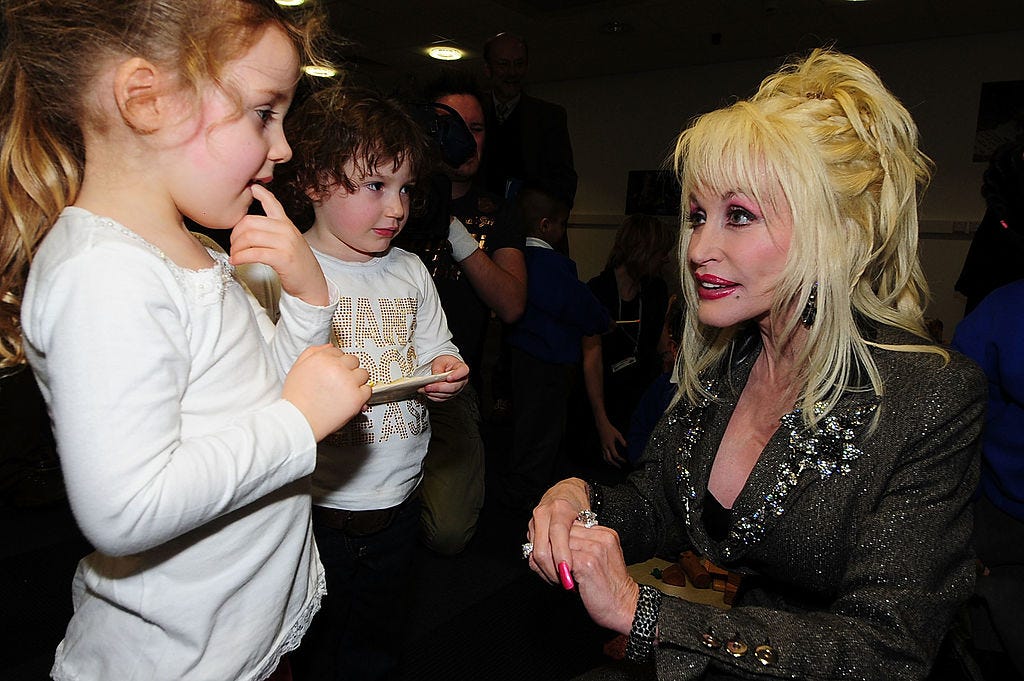
There have been many touching tributes to Dolly since her passing on Tuesday, including a cavalcade of clips to remind us of her beautiful buoyancy and her remarkable ability to spread joy, laughter, love and compassion. I can’t count how many times I’ve replayed “Jolene,” one of my all-time favorite songs that I never tire of hearing.
While Dolly’s rags-to-riches story from the Tennessee Smoky Mountains to a vast global stage is moving, that’s not the experience that made her life so meaningful; it was her commitment to use her talent and resources to spread happiness and improve lives. She didn’t put her early years behind her, but brought them with her to inform the choices she made as her life evolved.
That meant pursuing changes for limitations she saw. Dolly’s father never learned to read, for example. So she was motivated to launch the Imagination Library to distribute books to kids up to the age of five—more than 332 million over the last three decades. She saw friends and neighbors grow up with little education and without the social and economic mobility that it makes possible. So in recent years, she fully funded college tuition for employees at her Dollywood theme park in Pigeon Forge, TN, as well as some 11,000 full-time and part-time employees who worked at any of the two dozen amusement parks and attractions under Dollywood’s parent company. And when scientists were rushing to develop a vaccine for COVID-19, Dolly contributed $1 million to Vanderbilt University to help advance early-stage research.
There are few people in our collective life, especially at this deeply divided time, who are so widely beloved as Dolly. And what makes that so heart-warming is that—beyond the powerful allure of her music—the love stemmed from her ability to make everyone feel included for who they are. That included supporting the LGBTQ+ communities queer and expressing her desire for every vulnerable population “to be treated good.”
While she was reluctant to directly address politics, she made it clear in 2020, “I just do what my heart tells me to do…and God’s direction.” And she didn’t hesitate addressing Black Lives Matter—in her delightful way: “Of course Black lives matter. Do we think our little white asses are the only ones that matter?” And it wasn’t just talk: She invested millions of her royalties earned from Whitney Houston’s soaring 1992 version of her song “I Will Always Love You” into a Black area of Nashville.
Maybe Stella Parton, Dolly’s 77-year-old younger sister, Stella Parton, best summed up Dolly’s impact when she described as “one of the most generous, thoughtful and kind people I’ve ever known,” adding:
What the world saw is exactly who she was, so much so, she told me recently that if there was no hope for her, she would still allow her medical team to try experimental drugs in the hope of helping others in the future.
My sister was always thinking of others and if you want to honor her legacy, show more kindness, lift others up and give more of your time and resources as she continued to do to the very end.
Show more kindness, lift others up and give more of your time and resources. Sounds to me like a valuable message not only for how to live a good life, but also how to pay tribute to a gifted storyteller and beautiful human who embraced humanity and demonstrated the power of love.
Canada will not “fall in line”
If love offers one necessary counterpoint to the Trump regime, the fierce refusal to submit to a bully offers another. Enter Canada’s Mark Carney, who clearly decided he had had enough of Donald Trump and his foolish, hostile plan to impose 50 percent tariffs on many goods and services of our northern neighbor, long-time ally and principal trading partner.
Rather than absorb Trump’s vengeful attacks, Carney pledged dollar-for-dollar retaliation worth about $20 billion that is certain to cause harm to American states—and particularly red states—that count on Canadian trade. While Trump’s dumb plan led to talks between the two countries’ trade delegations, they quickly collapsed after Trump insisted that Canada should “fall in line” or face “far WORSE” than the existing tariffs.
This bullying escalated the dispute beyond economics into a matter of independence and sovereignty. “An attitude at the negotiation table that Canada is a subsidiary of the United States” is “not something we’re going to accept,” Carney said, also noting that “the Americans want to destroy our major industries, including autos, steel and aluminum.” This from a man who—before becoming Canadian prime minster—was governor of the Bank of Canada (2008 to 2013) and governor of the Bank of England (2013 to 2020).
Trump, meanwhile, underscored his lack of seriousness after his failure to intimidate Canada. "Look, I don't know how you feel about Canada. They are one of the worst countries in the world to deal with,” he said, then followed up by idiotically signing an executive order Thursday demanding Lake Ontario be renamed Lake America.
While the childish despot threw a tantrum, Carney plotted Canada’s future without the United States—a reality that will surely exacerbate the economic troubles facing such states as Michigan, Ohio and Pennsylvania.
“This fall we will begin intense discussions with the European Union, the world’s second-largest economy, to build a much stronger and deeper economic and security partnership,” Carney said, explaining that the EU can count on Canada being “trustworthy and reliable.” This is in contrast to Canada’s southern neighbor, of course.
This moment harks back to Carney’s important speech in January in Davos, Switzerland, when he made clear that Trump had accelerated the need for change. “We are in the midst of a rupture, not a transition,” he said, a phrase that tragically will endure. That meant making a break with the “the most powerful [who] pursue their interests using economic integration as a weapon of coercion.”
And Carney concluded with this: “We know the old order is not coming back. We shouldn’t mourn it. Nostalgia is not a strategy. But we believe that from the fracture, we can build something better, stronger, more just.”
Eight months later, Carney has demonstrated that he’s willing to back up these ideas with action. Maybe America’s angry toddler will backtrack and the two nations can find a middle road that will minimize the unnecessary damage.
But while I worry about the financial consequences for people and industries that depend on trade with Canada, I’m inspired by the defiant Mark Carney. In this moment, he’s one with all of us who say no to a foolish bully. May it serve as inspiration for other global leaders reluctant to cross this terrible man—just as Dolly’s full-hearted kindness and joy reminded us that we can be better and happier.
As the midterms approach, it’s more important than ever to support the survival of democracy and the expansion of independent media. While most of my posts are free, paid subscribers get full access to the dynamic comments sections, exclusive online chats, video recordings and more.
In this world where you can choose who to be, be Dolly.
If, under the canopy of our best values, we could wed Dolly's grit, heart and defiance with Mark Carney's grit, courage and defiance, we could birth a new nation that serves us a hell of a lot better.