

This prompt was originally published for Memorial Day in 2023 when Joe Biden was our president. It feels like a long time ago; I suspect most of us are thinking differently now about the demands of patriotism. Faced with a corrupt White House occupant hostile to our Constitution, determined to dismantle our democratic institutions and deny the people’s will, the stakes for America’s future have rarely been higher.
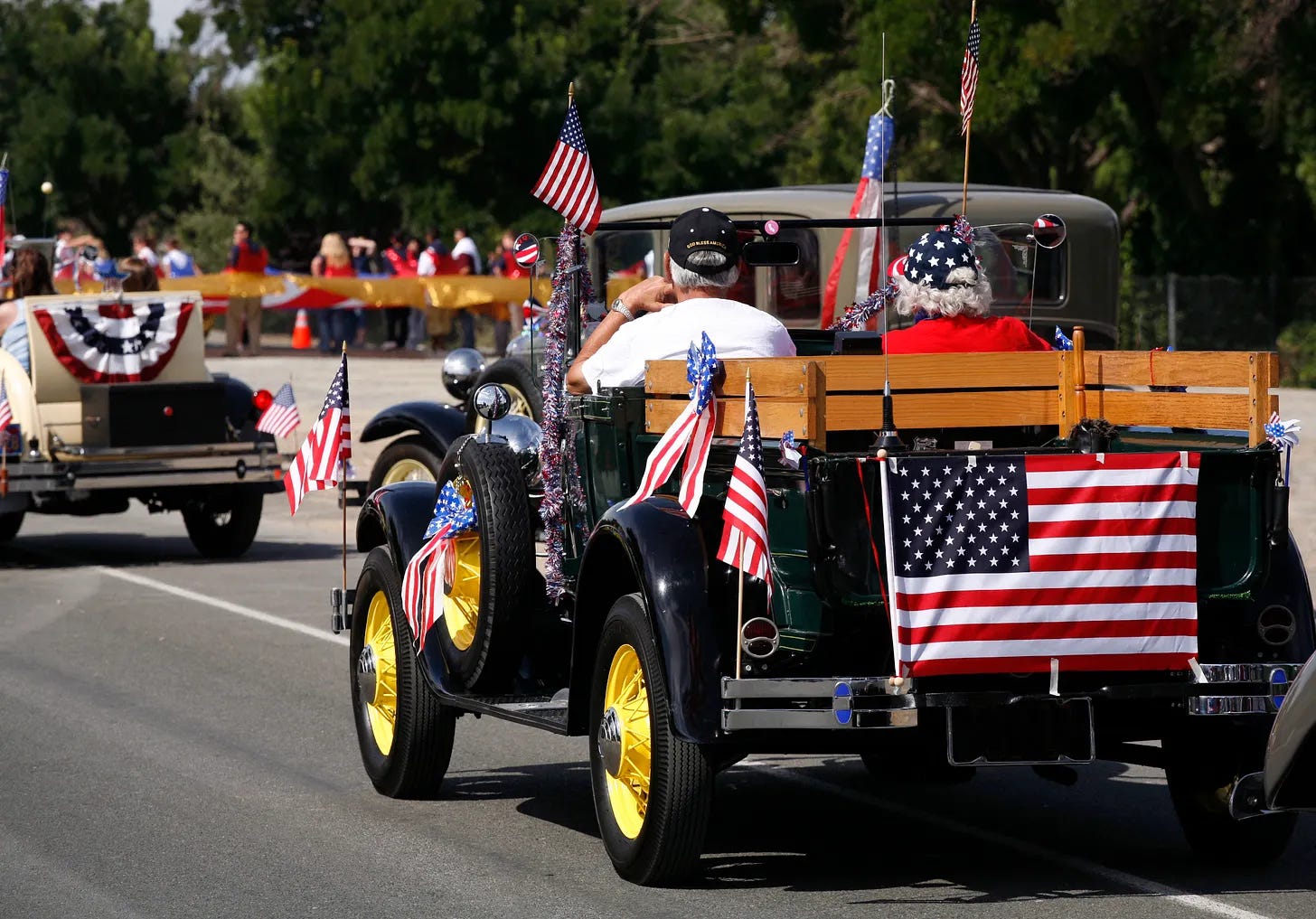
There once was a simple idea about patriotism. On a holiday like Memorial Day (or Veterans Day or Independence Day), put up a flag. Respect the military. Remember those who made the ultimate sacrifice. Maybe attend a parade with marching soldiers and floats and a brass band. Know your country’s history and system of government. Never criticize the president. Push back vigorously if you hear someone speaking against America. Proudly state the pledge of allegiance. Stand and sing the national anthem with your hand on your heart. Did I say never criticize the president?
Of course, these simple notions have never been adequate to encompass what it means to show patriotism, especially when actions like the Vietnam War or the Iraq War revealed deep division over government policy. “Love it or leave it,” the “real” patriots would angrily insist, as if they were the ones who really knew what it meant to be an American.
Recall the words of former President Theodore Roosevelt in May 1918 during World War I, who penned an editorial for The Kansas City Star to express his views of President Woodrow Wilson’s reluctance to strengthen the American presence in Europe. He sought to rebut those who questioned his right to say so.
The president, Roosevelt wrote, “should be supported or opposed exactly to the degree which is warranted by his good conduct or bad conduct, his efficiency or inefficiency in rendering loyal, able, and disinterested service to the Nation as a whole. Therefore it is absolutely necessary that there should be full liberty to tell the truth about his acts…To announce that there must be no criticism of the President, or that we are to stand by the President, right or wrong, is not only unpatriotic and servile, but is morally treasonable to the American public.”
Of course, in recent decades it’s not been hard to convince people of the appropriateness, indeed the moral necessity, of criticizing the president, especially when you believe he’s engaged in “bad conduct.” But this practice and the assumption of patriotism took a particularly dark turn in 2021 when the former White House occupant and his vehement followers called the Americans who violently attacked the U.S. Capitol on Jan. 6 “patriots”—rendering the traditional meaning of patriotism largely null and void. Beating police officers with flagpoles is showing love of country?
This is complicated stuff, not easily explored in brief. But rather than extend my own observations here, I want to urge you to share your thoughts. What does patriotism mean to you? Are there traditional habits that you enjoy? Do they provide you sustenance and in some ways strengthen your love of country? Can patriotism still serve as a unifying force or has that time passed? Has one side hijacked the concept of patriotism, undermining your willingness to share your thoughts and feelings? Can expressions of belief in democracy and justice help strengthen patriotic fervor?
As always, I look forward to reading your observations and the opportunity for this community to learn from each other. Please do be respectful. Trolling will not be tolerated.
Please consider becoming a paid subscriber for $50 a year or just $5 a month, if you’re not already. This helps sustain and expand the work of America, America, keep nearly all the content free for everyone and give you full access to the comments sections.
From the Conversation indicating patriotism dies in darkness as does democtacy. Last night, CBS News Radio went dark after nearly 100 years on the air.
The shuttering of the venerable media institution speaks to just how much the information landscape has changed in the internet age. Audience fragmentation and more news sources are not, on their face, a dangerous development. But when coupled with deregulation, corporate consolidation and the weakening of public interest requirements, these shifts don’t bode well for democratic deliberation and civic life, writes Penn State media scholar Matthew Jordan.
I would rather be in Normandy this Memorial Day. I could be with the spirit of true patriots who put their allegiance to our country above their own selfish interests. It’s hard to believe our country has been destroyed by the minority.