

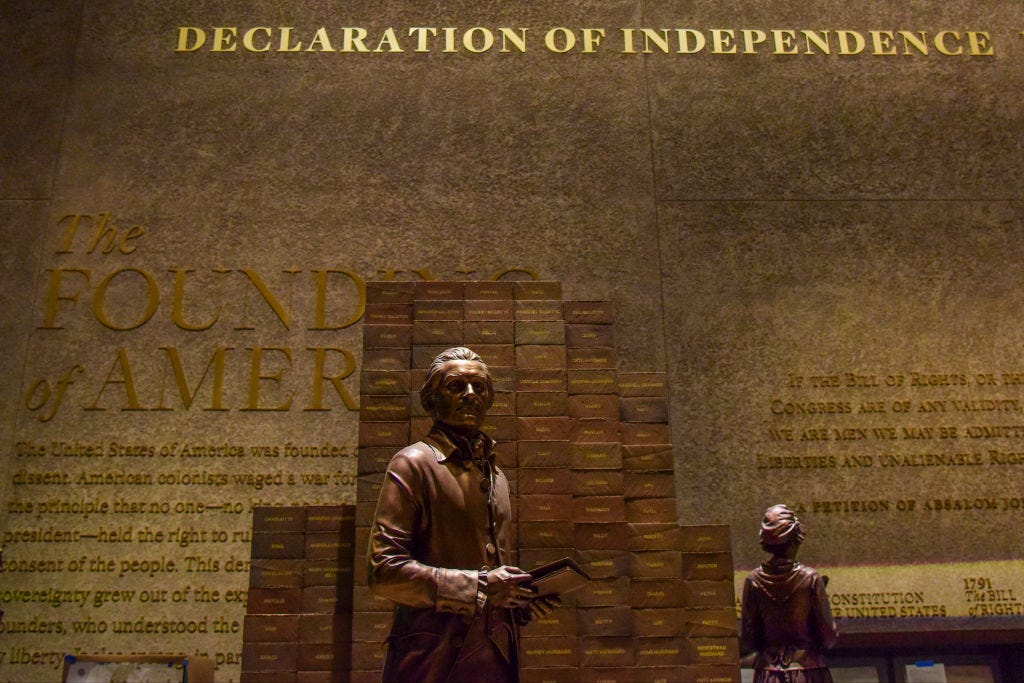
On June 12, 1776, Virginia’s Declaration of Rights, written by George Mason, was printed in the Pennsylvania Gazette. The language should ring a bell, as it begins with this:
That all men are by nature equally free and independent, and have certain inherent rights, of which, when they enter into a state of society, they cannot, by any compact, deprive or divest their posterity; namely, the enjoyment of life and liberty, with the means of acquiring and possessing property, and pursuing and obtaining happiness and safety.
If that sounds a little complicated, it was nonetheless an inspiration for the more gifted prose writer, Thomas Jefferson, when he was drafting the Declaration of Independence. Mason’s clunkier text became clearer, tighter and more essential with Jefferson’s pen: “We hold these truths to be self-evident, that all men are created equal, that they are endowed by their Creator with certain unalienable Rights, that among these are Life, Liberty and the pursuit of Happiness.”
These lines have been on my mind since meeting Lara Downes, a renowned classical pianist, recording artist, music curator and NPR host. She’s been developing “The Declaration Project,” culminating in a multimedia musical event keyed to the 250th anniversary of America’s founding and premiering at Lincoln Center in New York on July 1. Over the last two years, Downes has visited dozens of schools and community organizations and connected with thousands of people to share music and explore ideas about our country in this difficult time. “I’ve turned my road life into a reciprocal listening session,” she told me, “expanding my work far outside the traditional concert hall confines to redefine ‘audience’ and create dialogue in music and words with as many communities as possible.”
Yes, this effort is a musical one, leading to a show that will include three original classical compositions, as well as iconic American songs performed by a wide collection of musicians drawn from the worlds of jazz, bluegrass, cabaret, and more. Titled “Declaration: Songs of Democracy, Voices of Hope,” the concert will include well-known performers like Louis Cato, the bandleader for The Late Show with Stephen Colbert, and the historic Tuskegee University’s Golden Voices Concert Choir, a renowned choral group founded in 1886 by Booker T. Washington.
But as much as this milestone event is about music, it’s grounded in and motivated by the swirling and often fraught questions around what it means to be American. Downes has taken the time to explore both the individual stories and sense of shared heritage of Americans from all walks of life. This has included partnering with groups such as the Boys & Girls Clubs of America and the Metro Drug Coalition. “I wanted to understand the cultural climate of this time,” explained Downes. “To do that, I needed to step away from the algorithmic, inflammatory narrative of the news cycle and social media messaging, cut through all that noise, and listen to my listeners in the same focused, open-hearted way that they listen to my music.”
Motivated by concepts like empathy, community and unity, Downes has worked to pull together diverse perspectives typically divided by economics, age and cultural background. This brings us back to the foundational principles of life, liberty and the pursuit of happiness written down, said out loud and spread across our continent and the globe over these last 250 years.
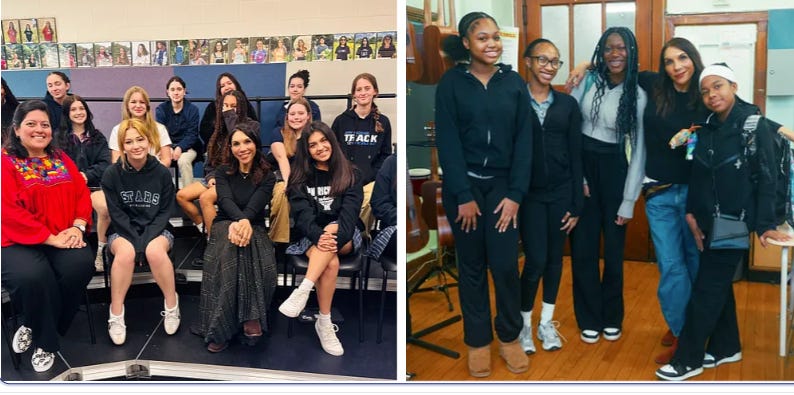
Downes has asked me if our America, America community can share our ideas, with the possibility that some of the comments could end up in the project’s digital archive or at Lincoln Center in July. We’ve agreed that it would be fascinating to learn how readers here understand Jefferson’s remarkable inclusion of “the pursuit of happiness” in America’s founding document.
Downes noted that many of the responses she’s gathered “gravitate towards an interpretation of ‘happiness’ as collective well-being…that the health and flourishing of community is essential to individual happiness.” So too, the desire for purpose. But I’m reluctant to say more. Instead, I ask you: What does “The pursuit of happiness” mean to you? Please do share your thoughts and observations here. No comments will be included in Downes’ “Declaration Project” without permission. You can listen to samples of other voices here.
As always, I look forward to reading your insights and the opportunity of the America, America community to learn from each other. Please do be respectful in your remarks. Trolling will not be tolerated.
Please consider becoming a paid subscriber for $50 a year or just $5 a month, if you’re not already. This helps sustain and expand the work of America, America, keep nearly all the content free for everyone and give you full access to the comments sections.
For me, contrariwise, the happiness is in the pursuit - the pursuit of a healthier, safer, more equal, more productive future for me and all the people around me. But this belief relies upon a positive forward outlook and an understanding that the pursuit is never over.
This is a thought-provoking substack post and it deserves a thoughtful response. I have been asking myself this a lot lately, so I presume you are asking for our heartfelt, deep yearnings on this topic, which has become much more relevant with this autocratic wallpapering of our democracy.
What IS happiness, indeed? Is it fulfillment of our deepest desires? Of our physical wants and needs? Of our perception that all is right with the world? Is it a deep faith that we shall all come together in community and support to help each other when we are troubled or in trouble or our democracy is in trouble, and that everything will “turn round right” in the end?
I know what it is not. Happiness is not fear of the future. Happiness is not the lonely isolation that feels like nobody cares what happens to others. Happiness is not mistrust of everything that we read or see on the news. I am not talking about discernment. That is a separate and distinct skill and I aspire to it…in fact it has become a method of survival. But when we can no longer agree on facts; when we cannot separate lies from objective truth or basic truths about our human condition and the ethics required of us to be as honest as we can so that we can live peacefully with each other…this, too, is not happiness. Happiness is not greed. Happiness is not salivating over power. Happiness is not scrambling over others with no regard for their humanity in order to catch the brass ring. Happiness is not deliberate deception. Happiness is not cruelty.
While happiness may be an individual thing, like the appearance of a shooting star where one says, “There it is! I see it and I feel it!”…some feel that this experience is enhanced by being with others. “There it is! WE see it! Do you see it? I see it! I feel it…do YOU?” That shared experience is heady. It is enlightening. It is inspiring. It is joyful. Those of us who dare may even call it…HAPPINESS.