

Iran is not Venezuela, where a surgical strike could result in the kidnapping of its leader and an end to combat. But let’s not doubt that in the simple and tragically reckless mind of Donald Trump, he fantasized that airstrikes by the world’s most powerful military could kill the Ayatollah Ali Khamenei and other top leaders and it would all be over: The regime would collapse, the Iranian people would rise up, a new dawn would begin and he could quickly collect the spoils of war. Trump Tower Tehran anyone?
In recent days, the despotic simpleton—determined to make his quick and neat fantasy real—declared victory, not once but over and over. He told supporters in Kentucky on Wednesday, “Let me tell you, we've won...You never like to say too early you won. We won. We won the bet. In the first hour it was over. But we won.”
He said it so many times that it sounded like he was trying to convince even himself. But Trump’s delusions and pathological lies are one thing, a war with a nation of 92 million people with a proud and ancient heritage and a regime that has been planning for a day such as this since the Iranian Revolution in 1979 is quite another.
The United States is now embroiled in the “F**k Around and Find Out” stage of Trump’s madness, fueled by war fanatic Pete “Maximum Lethality” Hegseth, surrounded by a confederacy of dunces who convinced Trump he could play out his fantasy, and undergirded by a feckless Republican-led Congress that does not know its constitutional purpose and refuses to say no to almost anything Trump does.
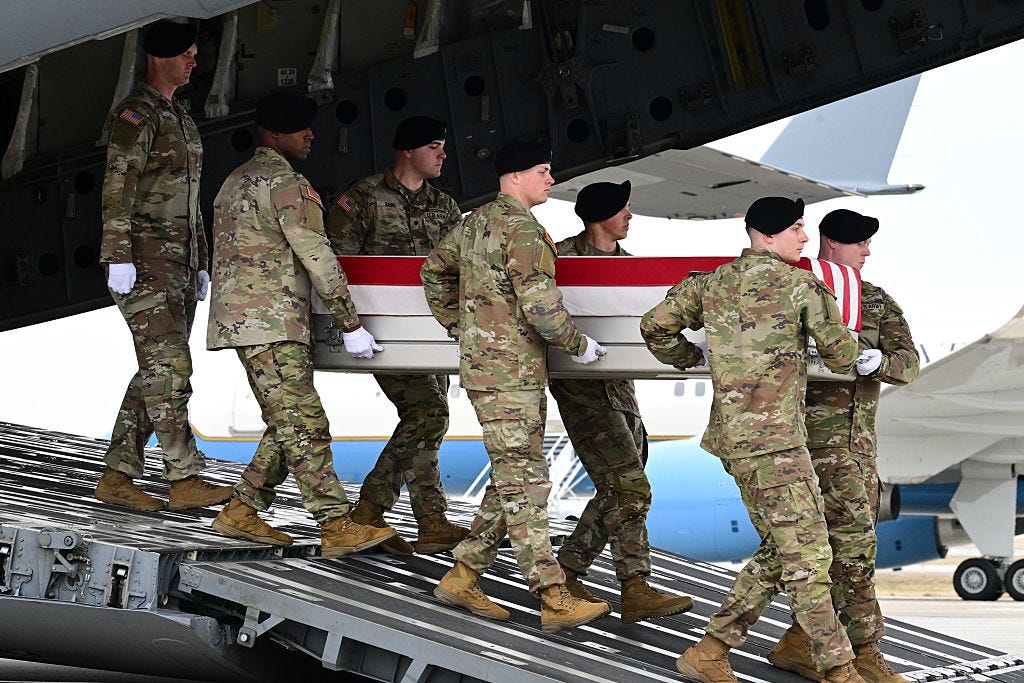
But as untethered from reality as Trump may be, events of the last few days have forced him to pay attention. The Iranians have blown up oil tankers in the Strait of Hormuz, an oil crisis beckons as ships carrying oil and gas cannot get to market, the stock market is plunging, the global economy is teetering and the death toll of American soldiers is rising (that reported number is currently 13).
Trump may have imagined that American military superiority is all it takes for an easy win, but he obviously failed to grasp how the Iranians could and would strangle its adversaries by blocking the shipping lane through which 20 percent of oil and natural gas passes. Trump pretended that there’s no such thing as an affordability crisis in America, but $100-plus barrels of oil mean rising prices for farmers and transportation and the cost of food that Americans eat.
A reckless White House occupant declaring victory is belied by an expanding military operation. News broke yesterday that the U.S. is sending to the region some 2,500 Marines on as many as three warships, including at least one amphibious assault ship that can carry fighter jets. This rising potential for boots on the ground followed the bombing of Kharg Island, the terminal for 90 percent of Iran’s oil exports.
Using his favorite verb, Trump posted that the military “totally obliterated every military target,” but did not attack its oil infrastructure. While threatening to “reconsider that decision” if the Strait of Hormuz remains choked off, the bellicose Trump offered this foolish fantasy: “Iran’s Military, and all others involved with this Terrorist Regime, would be wise to lay down their arms, and save what’s left of their country, which isn’t much!”
Yesterday reporters asked Donald “We Won” Trump when the conflict would end. "I can't tell you that," he said. "I mean, I have my own idea, but what good does it do? It'll be as long as it's necessary."
As long as it’s necessary. That doesn’t sound like an end date is coming anytime soon, not when the Iranians are prepared to use drones to counteract its enemy’s traditional military superiority. And not when the massive bombardments of Tehran hardened the resolve of the Iranian people against the U.S. military, making a mockery of the imagined picture of liberation. An accelerating stock market decline and increasingly furious Middle East allies (who fill Trump’s pockets) may convince Trump he cannot continue his war adventure—what he’s tried to minimize as “a little excursion—but history has repeatedly proven that exiting a war is always harder than triggering one.
So what do you think? When will the war end? Are we facing months of continued conflict and a rising death toll of American soldiers, as well as thousands more innocent civilians in Iran and the region? Perhaps you want to describe how you believe this will end. Perhaps you’d like to reflect on the tragic fact that it remains unclear why America is fighting this war, save for a sociopathic despot who feels free to follow his whims. Maybe you’d like to address who among his confederacy of dunces most alarms you. It would also be good to hear how motivated you are to engage in street protest; to date, the streets have been noticeably quiet. (One note: I will be talking to Indivisible’s Ezra Levin on Wednesday about the March 28 No Kings protest.)
As always, I look forward to reading your observations and the opportunity for this community to learn from each other. Please do be respectful in your remarks. Trolling will not be tolerated.
Please consider becoming a paid subscriber for $50 a year or just $5 a month, if you’re not already. This helps sustain and expand the independent journalism of America, America, keep nearly all the content free for everyone and give you full access to the comments sections.
The war will end when Israel declares it has ended. Anyone reading that and thinking I’m anti-Israel is wrong. Quite the opposite is true. A lot of good folks here and in Israel know where I’m coming from. This “excursion” is a man made mess. Ain’t no Messiah coming to bail us out.
We’re in the bomb dropping phase of a war that began long before the noise and the murder of school children. The bomb phase will likely end once we return to the gas lines of the early ‘70’s and middle America is paying $7 a gallon. But then the original war will again commence, fueled by even greater enmity than before. Trump will be remembered as Netanyahu’s bitch, and we’ll all get to think harder about crafting a civilization no longer reliant on the dinosaurs.