

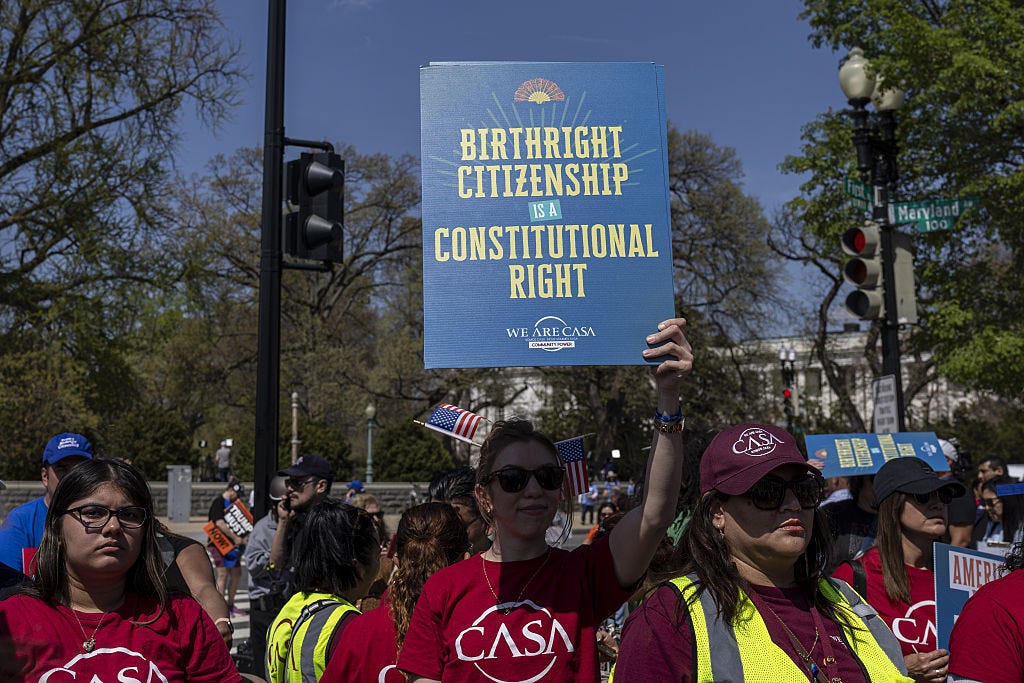
How dare these people. The 14th Amendment to our Constitution could not be clearer: “All persons born or naturalized in the United States, and subject to the jurisdiction thereof, are citizens of the United States and of the State wherein they reside.”
And yet this Supreme Court barely ensured this foundational protection for all babies born on U.S. soil, an amendment originally passed in 1868 that provided legal status for Black people freed from slavery. It was a right of citizenship achieved in the wake of the Civil War, indeed ratified out of the bloody sacrifice of hundreds of thousands of Union soldiers and others who supported abolition at great personal cost.
The vote in Trump v. Barbara to maintain birthright citizenship was 6-3, but in reality it was closer than that. Justice Brett Kavanaugh voted with the majority to strike down Donald Trump’s executive order that sought to ban birthright citizenship for the children of undocumented immigrants and some temporary foreign visitors. But he also expressed a partial dissent by saying his decision was based on a federal law rather than the Constitution.
The 26-page majority opinion was written by Chief Justice John Roberts, who plainly penned, "Under the Constitution, they are citizens at birth." He was joined by Justices Sonia Sotomayor, Elena Kagan, Ketanji Brown Jackson and Amy Coney Barrett. (You can read the entire ruling here.)
Meanwhile, Justice Clarence Thomas's dissent was nearly four times longer at 91 pages. He, along with Samuel Alito and Neil Gorsuch, who together comprise the most ideologically extreme of the court’s partisans, believe that it’s their privilege to overturn the contents of our Constitution to serve their racist agendas and fulfill the white supremacist desires of the man occupying our White House.
“The Court today takes the extraordinary step of holding facially unconstitutional the President’s Order excluding from citizenship the children of foreign temporary visitors and illegal aliens,” Thomas wrote. “In doing so, the Court adds to the sad history of the Fourteenth Amendment, which was designed and understood to secure equal rights for the freed blacks but has instead been repurposed for political projects that the Reconstruction Congress did not support.”
But let’s dwell for a moment on the concurring opinion written by Justice Jackson that specifically rebukes Thomas. “The Reconstruction Amendments were an anticaste, antisubordination reset for the Nation, not a mere spot treatment for the dark stain of slavery,” she wrote, noting danger that results from “the distortion of historical facts.” And this:
What is more, this alternative account [by Thomas] pitches Black Americans against immigrants when the advocates who promoted the Fourteenth Amendment did no such thing. Freed Blacks fought for the shared humanity of all people. And the Great Emancipator eventually foresaw that the only path forward that could prevent a return—in any form—to slavery and race-based subordination was to link the fates of all.
Of course, this is also a day to celebrate the success. “A president cannot change the Constitution by executive fiat,” said ACLU National Legal Director Cecillia Wang, who argued the case before the Supreme Court. Our brave clients and our legal team stand with millions of people around our country who spoke up for one of our most cherished rights. The Constitution’s guarantee of birthright citizenship stands strong.”
“President Trump suffered a stunning loss on a signature order he signed on day one of his presidency,” said ACLU Executive Director Anthony D. Romero. “This was one of the most important constitutional cases of the past 100 years.”
In a sane world—in which the Supreme Court would not seek to override the Constitution in order to serve its racist agenda or provide a reckless despot nearly unlimited power—the vote would not have been close. In fact, it would have been unanimous, assuming such a case were even to be taken up in the first place.
Yesterday’s decisions also included a 6-3 ruling that increases Trump's power to fire regulators and gain control over independent government agencies. This decision in Trump v. Slaughter is a dangerous escalation of his power, one which Georgetown University law professor Steve Vladeck called “the most important separation-of-powers ruling of the twenty-first century.”
I will not mince words: It’s another step in the Court’s efforts to create a dictatorial executive branch and the ongoing plot to destroy liberal democracy that's been underway for years.
We can add to this the supermajority’s role in advancing a society based on cruelty rather than humanity. This is exemplified by its 6-3 ruling last week to strip away the protections that 350,000 Haitians and some 6,000 Syrians counted on to live and work in the U.S. without the threat of deportation to home countries facing violence and unstable conditions. (I wrote about it here.)
Yes, we can also take some solace in the fact that the Court chose to not weigh in on the E. Jean Carroll case, ensuring that she will receive the $5 million she is owed and Trump will be forever marked as a convicted rapist.
But we should not minimize the threat this Supreme Court represents to our democratic republic in its rejection of equal justice and its desire to maximize presidential power. Reforming the Supreme Court must be at the top of the agenda for Democrats in the midterms and in 2028. That includes expanding the Court to dilute the extremists’ power and ending lifetime appointments.
Please consider becoming a paid subscriber for $50 a year or just $5 a month, if you’re not already. This helps sustain and expand the work of America, America, keep nearly all the content free for everyone and give you full access to the comments sections.
How does Justice Thomas purport to know what was in the minds of those who approved the 14th amendment, as if they didn't realize that birthright citizenship was defined broadly and would certainly extend far beyond the lives of former slaves who were granted citizen status? Not going to read his 91 page opinion, but WOW, what an interpretation.
Steven, I am glad you will not mince words. For all intense and purposes, we are living through a soft coup by; executive order, elimination of independent institutions, and a corrupt Supreme Court. Additionally, we have a corrupt two-party political system, and an ill-conceived Electoral College process which violates the popular vote of the President and Vice President, and aggressive state gerrymandering by both political parties. Got any idea who is actually working on these issues and what if any solutions are being proposed and discussed? I hear very little chatter regarding actually fixing these fundamental foundational flaws. How about you?